From Württemberg to California
by Kenneth
Baxter Wolf Part Two: The Wolf
Family in America: A follow-up to: Part
One: The Wolf Family in Germany: 1740-1853
(revised December
2025)
1853-1973
(including the
Bremermann, Keyt, Owen, Stuart, and Adams lines)
The Crossing
Late in her life, Amalie
Louise Wolf Geister (5/30/1840--1/19/1926), a
longtime resident of Pacific, Missouri, recorded
on a slip of lined paper
a few details
 about her arrival in America in
June, 1854. Translated from the German, it begins:
[I,] Amalie Louise Geister, nee Wolf, was born on
May 30, 1840 in Tailfingen, Württemberg. I
came with two of my siblings to America in June
1854." 33 Amalie's
recollection is corroborated by official records
from the time. The Württemberg Emigration
Index contains an entry for Amalie, as well as
for her sister Wilhelmine ("Minna") Wolf
(7/18/1832--3/13/1912), indicating that the two
applied for permission to leave the then Kingdom of Württemberg
sometime in 1854 with the intention of going to
Missouri. 34 Of their three brothers only Eberhard Ludwig
Wolf (12/6/1835--c. 1863) is listed in the
index, with an application date of July
1853. 35 But the names
of all five of the Wolf siblings appear in the
passenger lists of two separate vessels bound for
New York from Le Havre, Normandy. Gustav
Friedrich Wolf (6/4/1830--8/23/1860) and
Eberhard, ages 23 and 18, were among
the 398
passengers of the Trumbull,
a Brigantine sailing ship which arrived in New York
harbor under the command of William D. Smith, on
September 5, 1853.
36
 Nine and a half months later, on June 24, 1854, the
remaining Wolf siblings, Wilhelm Christian
Wolf (5/28/1831--12/10/1876), Wilhelmine
("Minna") Wolf, and Amalie Louise Wolf, ages 23,
21, and 14, arrived on the Antelope, with a total of 370 passengers on board. 37 Family momentos reflect
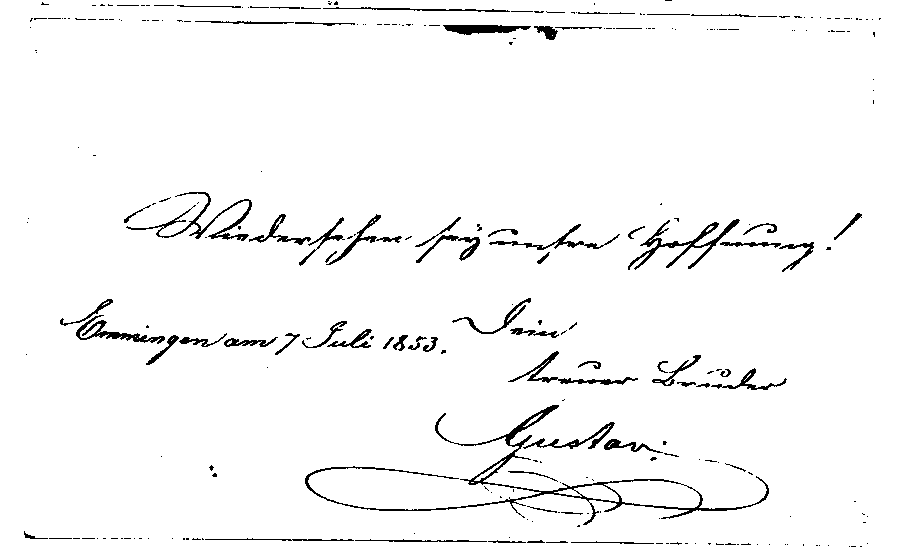
this two-stage emigration process. Gustav and
Eberhard each wrote farewell cards from Emmingen
on July 7, 1853, presumably on the eve of their
departure for Le Havre. Gustav's card--which
captures his florid signature--is signed "Dein
treuer Bruder" ("your faithful brother") and so
could have been directed at any one of the three
siblings that he left behind. Eberhard's note, which
begins "Schwester!" ("sister"), had to have been
intended either for Minna or Amalie. 38 Three days after Gustav
and Eberhard put pen to paper, their aunts
Auguste Caroline Baumgarth and
Friederike Philippine Baumgarth (sisters of
their recently deceased mother, Heinrike Eberhardine
Baumgarth Wolf) wrote similar cards from Emmingen
(7/10/1853), each identifying herself as a
liebende Tante ("loving aunt"). Given the
timing of these notes, they must have been
presented to Gustav and Eberhard on the eve of
their voyage. Finally, in a goodbye-card dated April
29, 1854, Heinrike Eberhardine Wolf (the
oldest daughter of Johann Jakob Wolf's
brother, Christian Friedrich Wolf) bid
farewell to her cousine ("female cousin")
from her home in Eßlingen. The date on this
card--April 29, 1854--is our best guess as to when
Wilhelm and his sisters set out for Normandy to
meet the Antelope.
 In any case, it is clear from all of this that
Gustav, the oldest of the siblings, went to
America first, taking his younger brother Eberhard
with him, with the intention of paving the way for
the arrival of their two sisters in Wilhelm's
charge.
The timing of the Wolf family's departure placed them squarely in the middle of the most active phase of German migration to the United States. It is estimated that more than a half million Germans immigrated to America between 1850 and 1854, with the single largest burst occurring precisely in 1853-54. 39 There were many factors behind this largescale mid-century emigration from Germany, prominent among which were crop failure, political instability, land inheritance problems, and peasant emancipation. 40 Of all the U.S. ports of arrival, New York was by far the most active in terms of immigration, handling 74% of the foreign arrivals by sea (which numbered 175,190) in 1853 and 71% (201,580) in 1854. In 1853, 40% of foreign passengers to the United States were German, second only to the Irish (42%). 41 In 1854, the percentage of Germans increased to 48% while the Irish, the next largest group, accounted for only 22%. At this point, there was no distinct processing center for immigrants in New York. The first of these, Castle Garden (a.k.a. Castle Clinton) in Battery Park, opened in 1855 in response to the recent surge of immigrants. Ellis Island would follow in 1890. The ship masters of the Trumbell and Antelope would have simply submitted their lists to the customs officials, who would then have processed the passengers and released them into the city. 42
It is worth noting that
immigrants coming from southern Germany and the
Rhineland often left from the French port of Le
Havre. Northern Germans tended to use Bremerhaven.
Because American cotton bound for the mills of
Alsace entered France via Le Havre, many of the
ships, emptied of cotton, would be filled with
immigrants in an effort to make the return voyage
profitable. 42a As a
result, many southern German immigrants found
themselves in Louisiana, where they boarded river
boats to make their way up the Mississippi. This
was not the case for the Wolf family, whose ships
sailed from La Havre directly to New York.
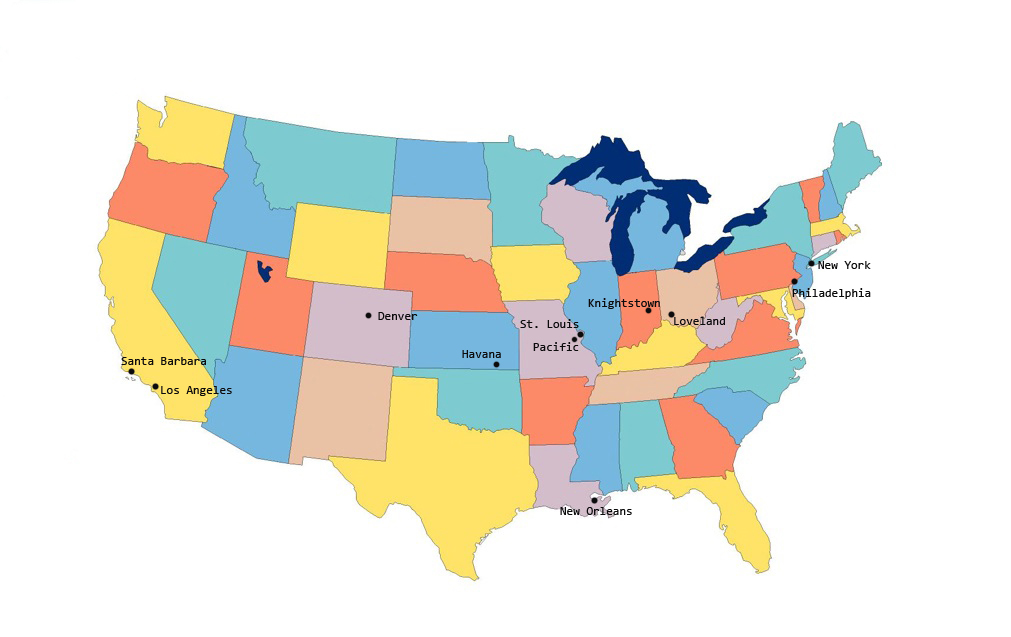
When the Trumbell
arrived in New York harbor, the two Wolf brothers
parted paths for a time. While Gustav seems to
have gone directly to St. Louis, Eberhard made his
way south to Philadelphia. There he met and
married another immigrant named Louise from
Fellbach, Germany and fathered three children in
the space of three years. But by the summer of
1859, Eberhard and family had left Philadelphia
and joined the rest of the Wolfs in St.
Louis.  Naturalization records
definitely place Eberhard in St. Louis on August
1, 1859, when, as part of the naturalization process, he officially renounced his
allegiance to the King of Württemberg. 43 His brother Gustav served as a witness, swearing, among other things, that his brother had lived in the United States for at least five years and in Missouri for at least one year up to his time of application. The 1860 Census,
taken the following year, found Eberhard working
there as a 26-year-old cabinet maker and living
with his wife Louisa (age 25) 44, and four
children: Frederick (age 6), Charles
(age 5), Wilhelm (age 3), and Louisa
(age 1). While the census entry lists Philadelphia
as the birthplace of the three boys, little Louisa
is identified as a St. Louis native. There is some confusion
about the date of birth of Eberhard's second son,
Charles Gustav Wolf. His death certificate
records his birth date as June 22, 1854 while his
headstone reads June 2, 1855. 45 The later date turns out
to be a better fit. For one thing, if Charles were
born in 1855, he would have been five years old in
1860, just as the census data indicates. 1855 also
makes more sense in terms of Charles's
chronological relationship with his older brother.
For if Charles had been born in June of 1854,
Frederick could not have been born any later than
September, 1853, the very month in which his
father arrived from Europe. There were two women by the name of Louise (or
Louisa) on board that ship: Louise Klein (Prussia) and
Louise Obert (Baden), both 20 years old. Given her ties to Baden, it is
possible that Louise Obert was the future Louisa
Wolf. But it is more likely that Eberhard met his Louisa in
Philadelphia and married her shortly thereafter,
with Frederick entering the world sometime in the
middle of 1854 and Charles, a
year later.
The St. Louis that greeted
the Wolf family was a very German city. Already by
1837, an estimated 6,000 Germans called St. Louis
their home.
 and that number would grow dramatically over the
next two decades, partly in response to the
exaggerated claims about this new American
"Rhineland" that were circulating at that time in
Germany. According to Emil Mallincrodt, founder
(in 1844) of the German settlement of Bremen--
which is now the Hyde Park neighborhood of St.
Louis--"One often imagines he is in Germany when
he hears German and the sound of wooden shoes
clattering on the streets." 46 The influx of German
Lutherans also affected the religious topography
of the city, with the foundation of Trinity
Lutheran church and the establishment of Concordia
Seminary in 1849. Though
the rate of immigration from Germany to St. Louis
peaked in the 1850s, large numbers of German
immigrants continued to pour into the city for
another half century, dominating its cultural
identity until the advent of WWI, when anti-German
sentiments ran high and German Americans began to
downplay their ties to the Vaterland
Gustav Friedrich Wolf in St. Louis
 When Gustav first surfaces in the extant
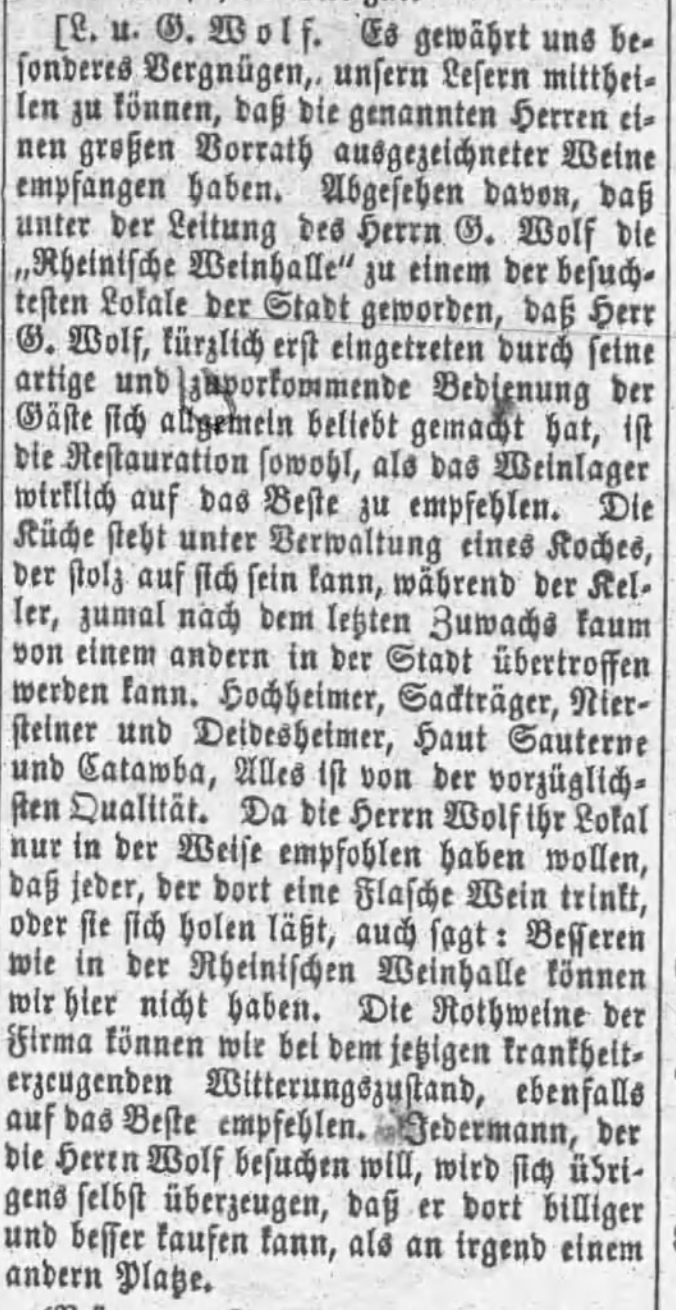
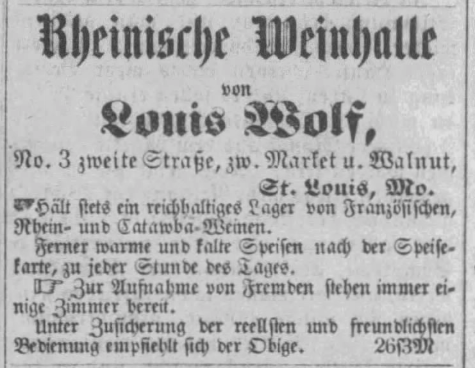
records of his adopted country, he does so as someone already established in the hospitality industry of St. Louis. The May 27, 1855 issue of the German-language newspaper Anzeiger des Westens contains an elaborately worded announcement, calling its readers' attention to a new shipment of "excellent" wines available at the Rheinische Weinhalle ("Winehall of the Rhine"), the proprieters of which are identified as "L. und G. Wolf." It states that under the "leadership of Mr. G. Wolf, the Rheinische Weinhalle has become one of the most sought after pubs in the city." And similarly: "Anyone who visits the [two] Mr. Wolfs will be convinced that there he can buy cheaper and better [wine] than anywhere else." Customers could expect a range of wines, some of which were imported from the Rhine region (Hochheimer, Sackträger, Niersteiner, and Deidesheimer), and others produced domestically (Haut Sauterne and Catawba). The advertisement refers to two different components of the establishment: a wine cellar (Weinlager) and a restaurant (Restauration). The "L. & G. Wolf" company name turns up again in the "Abstracts of the Proceedings of the St. Louis County Court" section of the St. Louis Globe-Democrat (April 25 1856), as the recipient of a dram shop license, which allowed the Weinhalle to serve alcohol. The company lasted only another year after this license was acquired. The April 25, 1857 edition of the Anzeiger des Westens ran a notice under the heading "Partnership-Auflösung" (Parnership-Dissolution), indicating that the L. & G Wolf company had officially come to an end, and that "Louis Wolf" would henceforth have full control of the hitherto joint business. Happily for us, this brief, official notice in the paper actually spells out both names of the former associates, "Louis Wolf" and "Gustav Wolf," thus dispelling any doubts as to the identity of the "G. Wolf" in the original 1855 advertisement. Beginning October 3, 1857, Louis began running regular ads in the Westliche Post, touting the products of the Rheinische Weinhalle von Louis Wolf. These same ads allow us to locate the Weinhalle on Second street between Market and Walnut. Before leaving the subject of Gustav's earliest known foray into business, it is worth noting that, though he and Louis shared the same last name, they do not seem to have been related. There is no one among our Wolf immigrants who bears the name Louis. Gustav's younger brother, Eberhard had "Ludwig" as a middle name, and it is easy to imagine him translating it as part of his new American identity. But, as we saw above, Eberhard made for Philadelphia right after the Trumbull docked in New York. He ended up staying there for five years--that is from the fall of 1853 until 1858, after which he moved to St. Louis with his German-born wife and their three children, all of whom had been born in Philadelphia. Eberhard was simply too far away for him to have partnered with his older brother in St. Louis between the years 1855 and 1857.
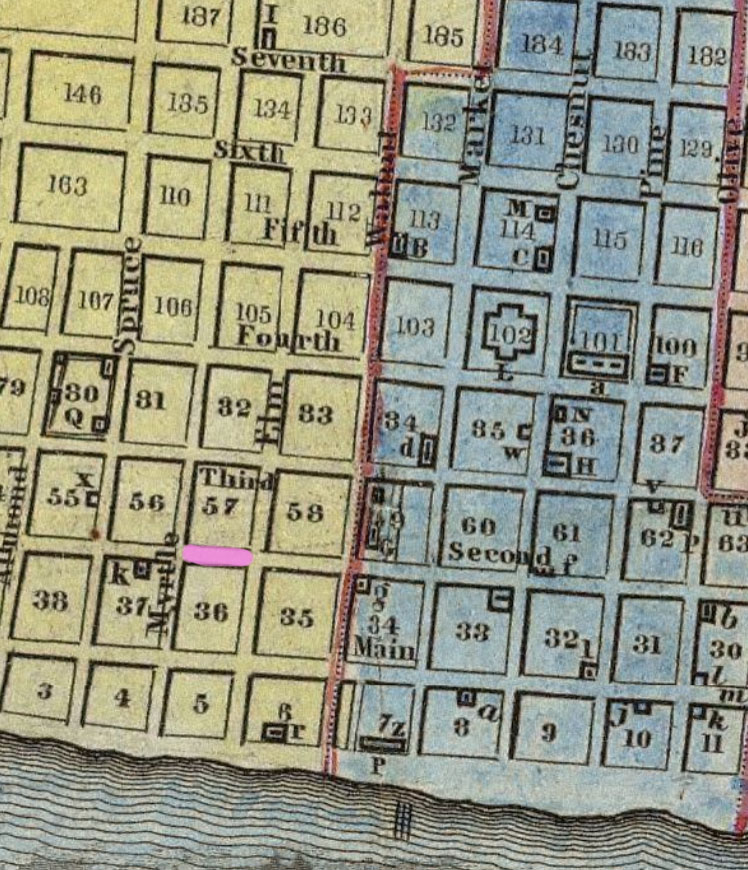
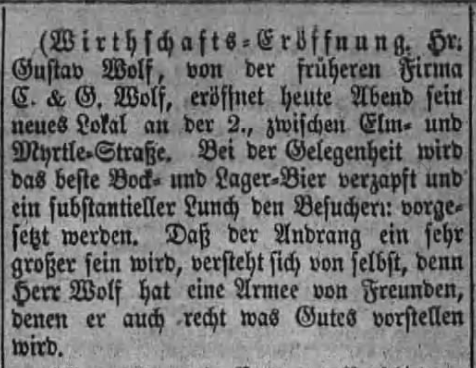 The timing of Gustav's first solo venture lines up well with that of his disengagement from the Rheinische Weinhalle. The April 30, 1857 edition of the Anzeiger des Westens announced the opening, that very afternoon, of a new beer and lunch venue at 57 Second Street. "Business opening: This evening Herr Gustav Wolf, from the former L. & G. Wolf company, is opening his new pub (Lokal) on Second street, between Elm and Myrtle. On this occasion, the best Bock beer and Lager beer will be served and a substantial lunch will be offered to any visitors. Of course the crowd will be large, because Herr Wolf has an army of friends, for whom he will set out something quite good."
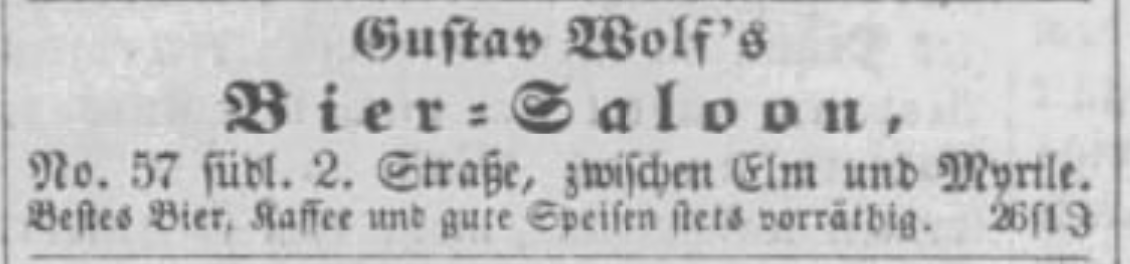 From them on little newspaper ads began appearing on a regular basis: "Gustav Wolf's Bier Saloon, No. 57 South Second Street, between Elm and Myrtle. Best beer, coffee and good dishes always on hand."
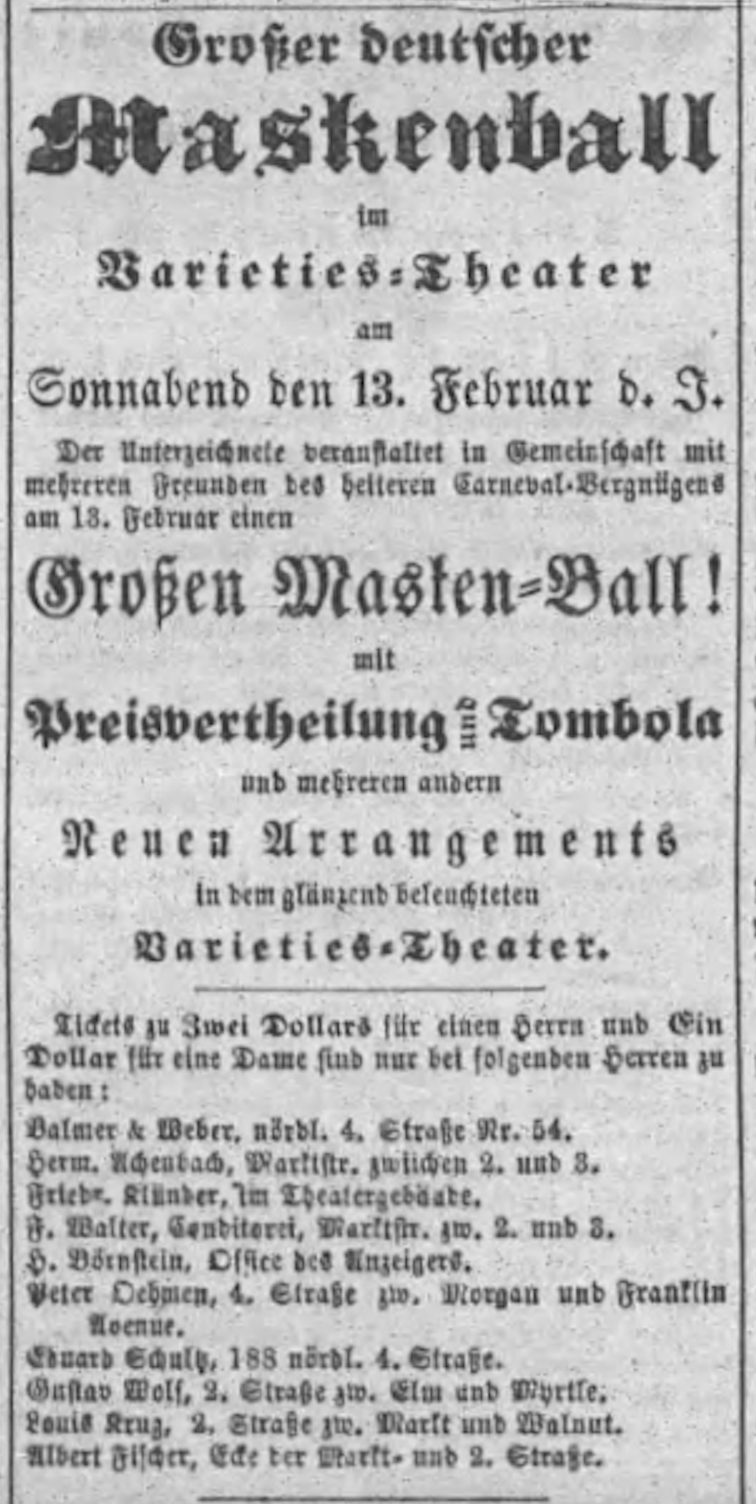
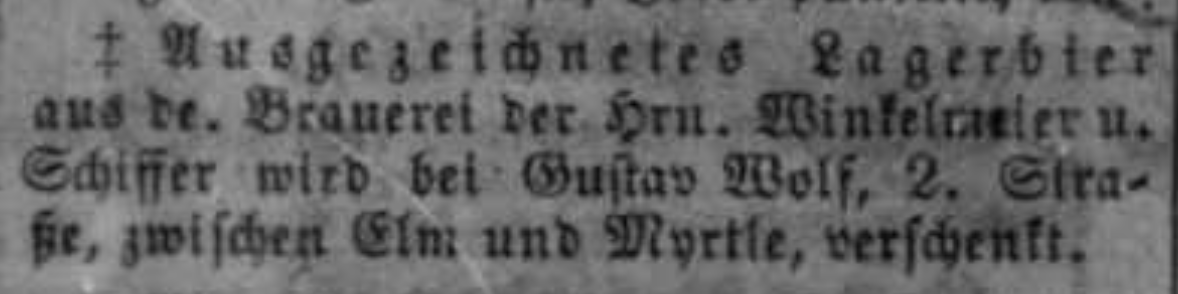 Other references to Gustav's pub in the local German press suggest that he did what he could to grow his customer base. An advertisement that appeared on April 30, 1858 reads: "Outstanding Lager beer from the brewery of Herr Winkelmeier and Herr Schiffer will be given away at Gustav Wolf's, Second Street between Elm and Myrtle." Presumably with a similar aim, Gustav offered up his establishment as one of ten locations where residents of St. Louis could purchase tickets to a Great German Masked Ball (Grosser Deutscher Maskenball) to be held at the Varieties Theater on February 13, 1858 (Anzeiger des Westens Jan 26 1858).
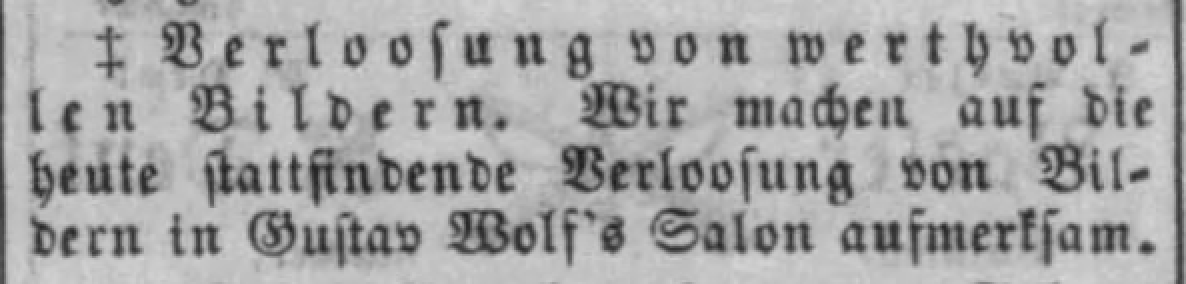
 Later that same year, "Gustav Wolf's salon" served as the site of a "Raffle of Valuable Pictures" (Westliche Post Nov 6 1858).
The Westliche Post carried daily ads for Gustav Wolf's Bier Saloon from October 1, 1857, until February 18, 1859. The following day, the wording of the ads changed to Joseph Kunz's Bier Salon, with the telling parenthetical addition: Früher (formerly) Gustav Wolf's. It turns out Gustav had since become the proprietor of the Restauration (Restaurant) und Hotel Garni at 25 Market Street, which opened for business on November 25, 1858. Gustav seems to have managed both of these establishments for eight months before letting the Bier Saloon go. Two consecutive entries in the St. Louis Directory of 1859 indicate that Gustav Wolf ran a hotel and restaurant at 23 Market Street and a saloon at 56 S. 2nd Street, the two addresses apparently corresponding to adjacent sides of the same corner building.
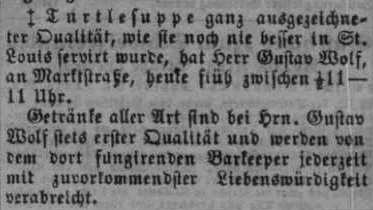
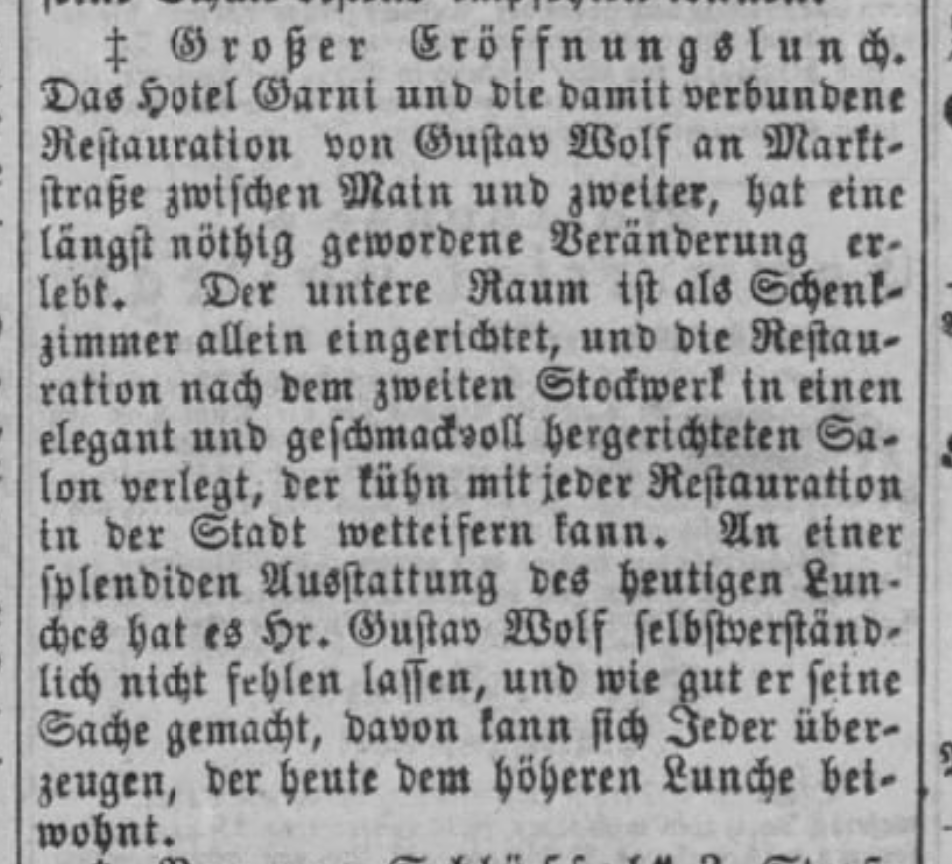
Again the newspaper advertisements add dashes of color to what we know about Gustav's new business. On June 17, 1859, the Westliche Post ran a short advertisement, touting a special of the day: "Today between 10:30 and 11:00 a.m., Gustav Wolf on Market Street has turtle soup of quite excellent quality, no better version of which is being served in St. Louis." Three months later, the September 15, 1859 edition of the same newspaper ran an advertisement for a "grand opening lunch" (Großer Eröffnungslunch), designed to show off a substantial remodel. As the result of this transformation, the lower room was henceforth dedicated to a Schenkzimmer (a wine and beer bar), while the "elegant" salon on the second level housed the restaurant.
On September 23, 1859, the eve of the Fourth Annual fair of the St. Louis Agricultural and Mechanical Association, the St. Louis Globe-Democrat published an article listing all the local hotels waiting to serve the needs of prospective visitors, including Gustav Wolf's. 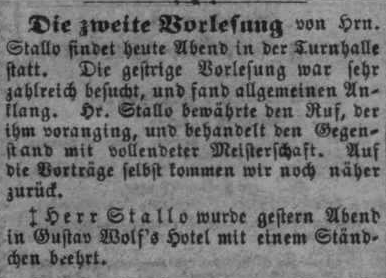 The very next day, the Westliche Post (Sep 24 1859) announced a "second lecture of Herr Stallo"--that is, John Stallo, a well-known German-American academic, jurist, philosopher, and ambassador--that afternoon at the Turnhalle (Gymnasium)," noting that the previous evening after his first address Stallo was treated to a serenade "in Gustav Wolf's hotel."
The Westliche Post ran an ad on March 10, 1860: "Mr. Gustav Wolf, on Market street between Second and Main, is currently pouring Rhine wine at 15 cents a glass (per Schoppen), and one would be hardpressed to find its equal at this price.
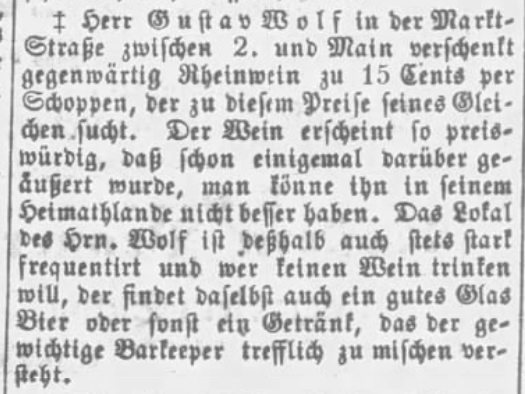 The wine is regarded as so inexpensive that already it has been noted several times that one cannot find a better deal even in the homeland. As a result, Mr. Wolf's place is always busy and heavily frequented. Anyone who does not wish to drink [Gustav's] wine, will also find a good glass of beer, or a different drink, expertly-mixed by the knowledgeable bartender." Other advertisements that Gustav ran at about this time kept his customers informed about the arrival of new shipments of wine from the old country.
Somewhere in the midst of this flurry of entrepreneurial activity, Gustav initiated the process of becoming a citizen of his adopted country. Records indicate that he succeeded in becaming a citizen of his adopted country on the last day of March, 1859, four months before serving as a witness for his brother Eberhard's own naturalization process.
 Less than a month later, Gustav's luck began to change. The Hermanner Volksblatt, the German-language newspaper of Hermann, Missouri (some 80 miles west of St. Louis), ran a story on April 28, 1860 describing a fire that caused significant damage to Gustav's hotel in St. Louis. It began about 2:00 a.m. at the neighboring gun shop at 27 Market St. By the time it was extinguished, seven rooms of the hotel were destroyed either by the flames or by the water that was used to extinguish them. No one was killed, though a number of hotel guests suffered from smoke inhalation. Gustav himself actually passed out and had to be carried out of the building. Happily his wife and baby (see below) were fine. Aside from the affected rooms, the rest of the Garni, in particular the restaurant, survived intact. According to the article, Gustav had insurance to cover the cost of the repairs.
Shortly after the fire, the 1860 census takers (who completed the pertinent portion of their work on June 28) identified "Gustavus Wolf" as a resident of the Third Ward in St. Louis and a "keeper of restaurant." The entry has him (age 30), living with his young wife, "Mary," age 23, and their son of ten months, Eugene Wolf (8/23/1859--7/30/1901).47 We know from other sources that Gustav's wife's name when he met her was Marie Louise Kübler (1838--3/16/1918). Beyond the three family members, Gustav's household also included a fourteen-year-old servant from Bavaria named Clara Kuhn; and two clerks, who presumably would have helped run the hotel and restaurant, named Alexander Miller (age 21 from Baden, Germany) and Frederick Bushings (age 27, from Hannover).
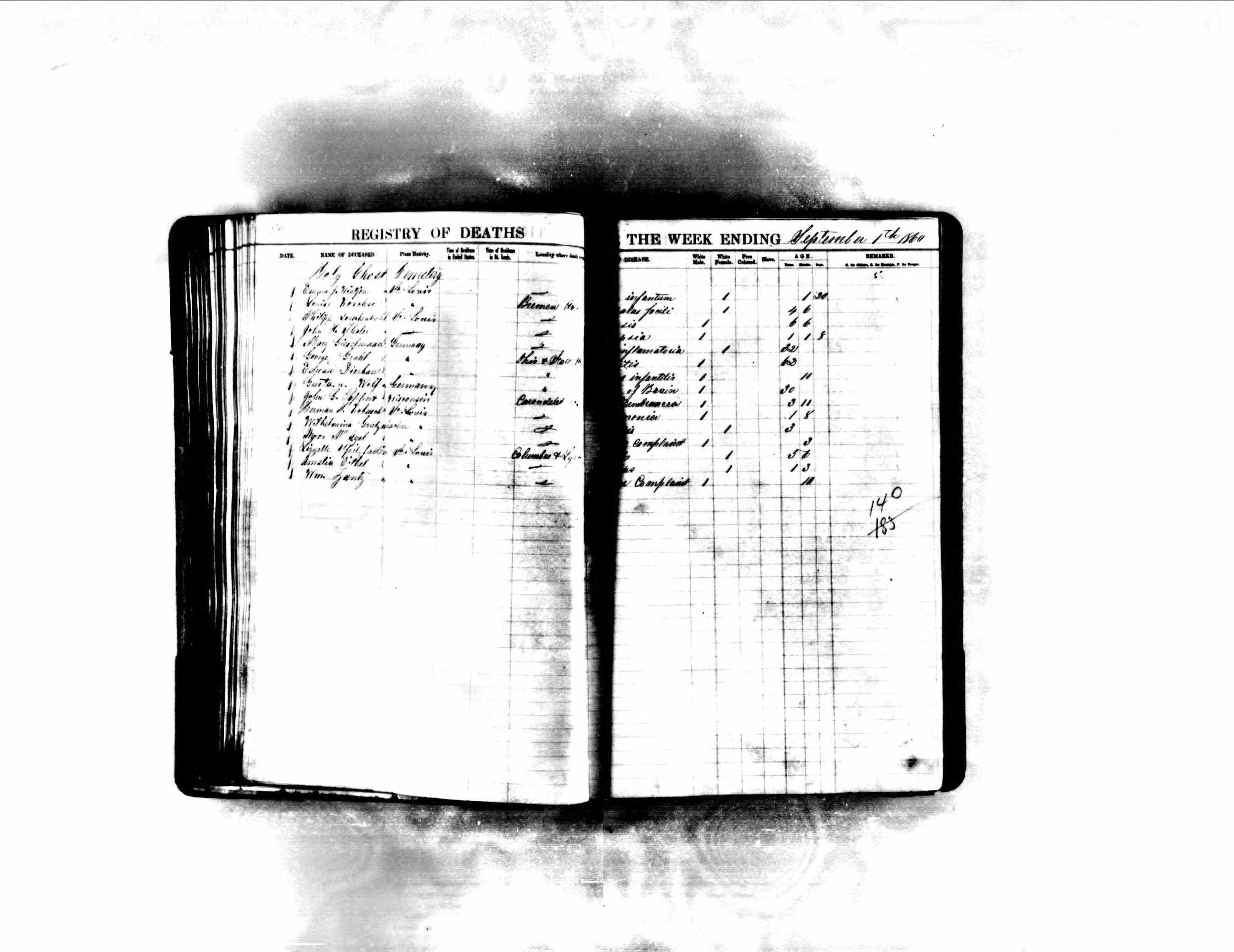
There is no indication in the "Gustav Wolf" census entry that Gustav was sick at the time. And yet we was sick; so sick, in fact, that he died only two months later. That was August 23, 1860, which (as cruel fate would have it) happened to be little Eugene's first birthday. An entry in the St. Louis Registry of Deaths lists one "Gustavus Wolf" of Germany, age 30, as the victim of a "disease of the Brain," expiring sometime during the week that ended on September 1, 1860."48 The records of the Holy Cross cemetery in St. Louis, where Gustav was interred, indicate that the actual date of death was August 23. The only obituary I have been able to locate is the one from the August 25 edition of the Hermanner Volksblatt. It reads (in English): "From St. Louis the sad news comes to us that the well-known Mr. Gustav Wolf, who ran the popular restaurant on Market Street, was taken by death on Thursday morning [i.e., August 23]. His friends had feared for him for some time, yet his death was sudden. A very young wife and a one-year-old child mourn their painful loss. Sit illi terra levis [Latin: "May the earth be light upon him"].


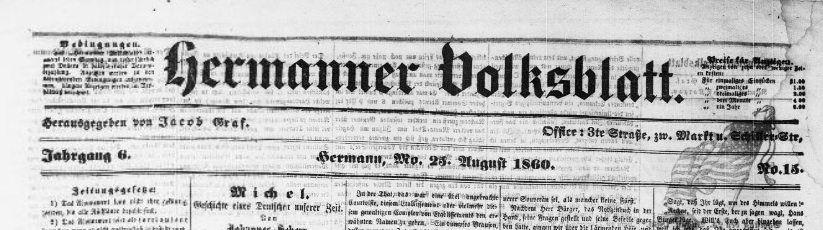
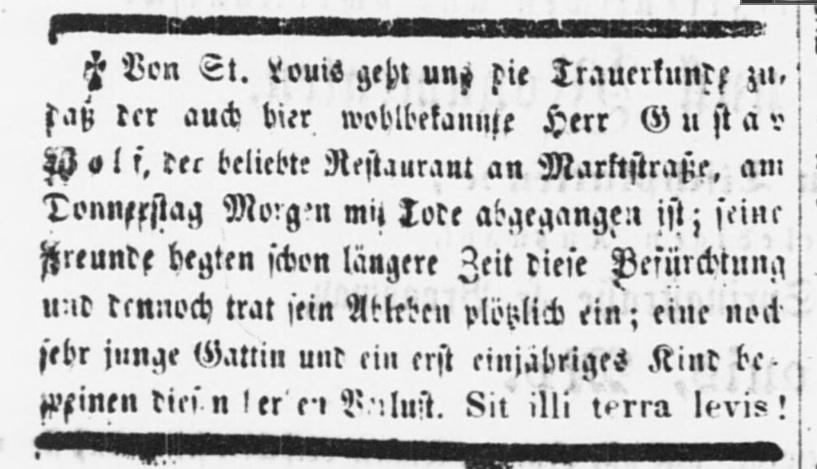
Von St. Louis geht uns die Trauerkunde zu, dass der auch hier wohlbekannte Herr Gustav Wolf, der beliebte Restaurant an Marktstrasse, am Donnerstag Morgan mit Tode abgegangan ist; seine Freunde hegten schon laengere Zeit diese Befuerchtung und dennoch trat sein Ableben ploetzlich ein; eine noch sehr junge Gattin und ein erst einjahriges Kind beweinen diesen herben Verlust. Sit illi terra levis!]
The funeral cost $62.50. That amount included the plot and the coffin, as well as the hearse and carriage rental.

The August 25 (Saturday) edition of the Westliche Post of St. Louis published a short but florid description of Gustav's funeral procession, which had taken place the previous day. There is no mention in it of Gustav's widow or son. Instead a lot is made of the fact that his coffin was escorted to the cemetery by an honor guard led by Captain Stifel of the "Missouri Dragoners," of which Gustav had been an "honored member" (Ehrenmitglied). The Missouri Dragoners (or Dragoons) was a local German militia, originally formed by Woldermar Fischer, a St. Louis merchant and a former Prussian officer. The group participated in the Mexican American War (1846-1848) under the official designation "Company B, Missouri Light Artillery Battalion." All this, of course, predated Gustav's arrival in America. The group's activities in subsequent years were less dramatic and therefore unpublicized. 49
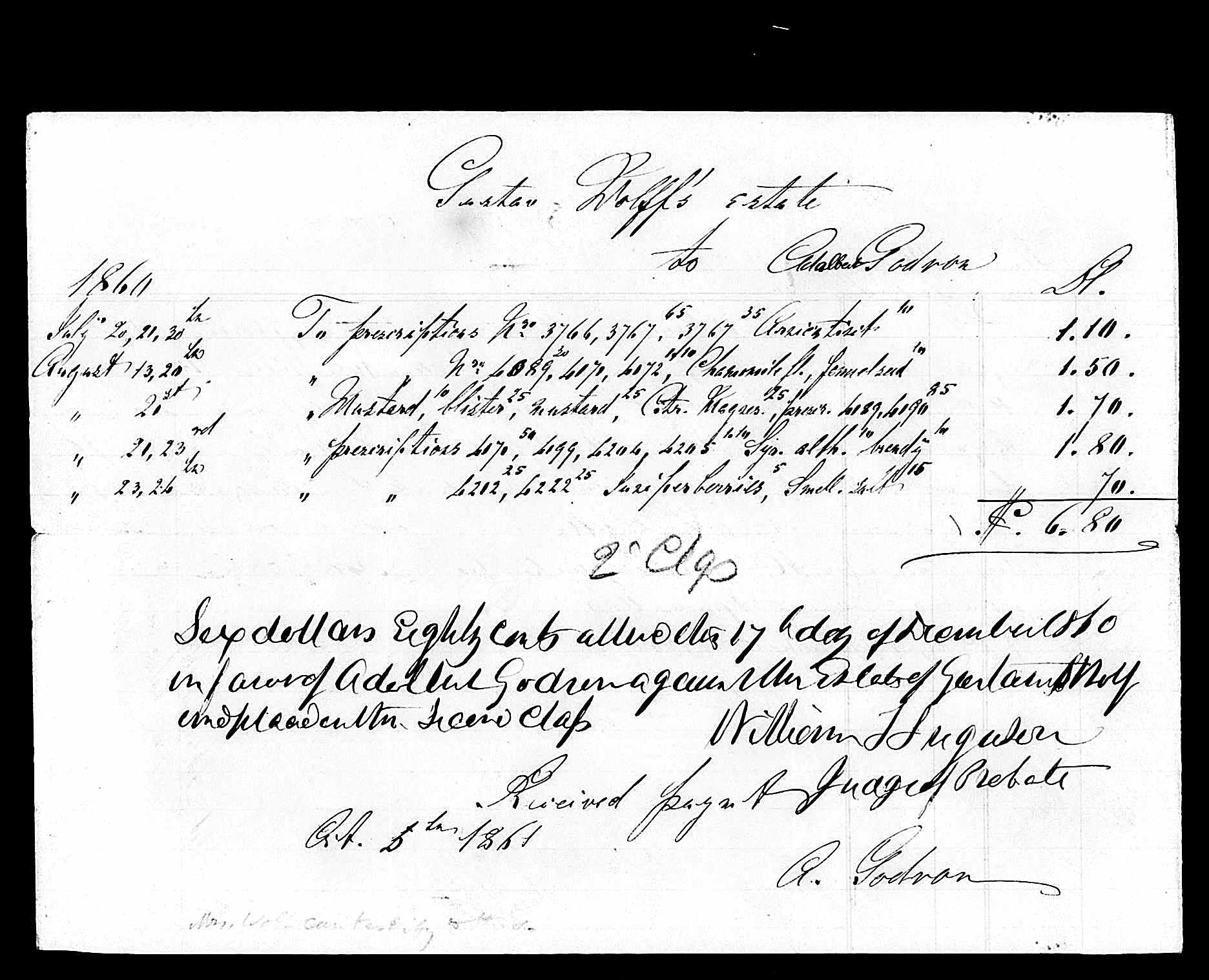
What exactly was the "disease of the brain" that took Gustav's life? 50 Probate records include claims made against his estate by those who treated him over the course of the last five months of his life. An invoice submitted by Dr. Philip Weigel shows that made multiple housecalls to the Wolf home beginning on March 19, 1860, and culminating on August 23, the day Gustav died. Unfortunately the bill is not very specific when it comes to his treatments, mostly referring to "medicines" and "prescriptions" without identifying them. There are only two exceptions to this rule: the "four galvanic operations that were administered on May 2, 3, 5, and 7, and the "visit at Ferzinger's (or Herzinger's) Water Cures." The mid-nineteenth century was the heyday of the therapeutic use of electric currents as well as hydrotherapy ("water cures"), but unfortunately the maladies for which these technologies were prescribed are so wide-ranging that they are of little help when trying to determine Gustav's actual cause of death. The other medical bill, submitted by Adalbert Godron, covering charges from July 20 to August 24, is equally reticent about Gustav's condition, listing (alongside a series of prescriptions identified only by number) what we would today consider more homeopathic remedies: Chamomile fl(ower), fennel seed, mustard, juniper berries, "blister" (root?), and smelling salts.

Though we have no information about the symptoms of Gustav's malady, they seem to have been slowing him down for some months before his death. On June 4, 1860, the Westliche Post ran an advertisement that doubled as an apologia for the Restauration und Garni of Gustav Wolf on Market Street. It explained that the running of the restaurant and hotel had only days before been handed over to one Christian Fluhr, who had served as a cook at the Virginia Hotel before (more recently) joining Gustav's staff. The notice was intended to assure customers that they could expect the same high quality of service under this new management, and that "Max" (who must have been a well-known figure at the hotel/restaurant would still be there welcoming them at the door. There is no mention of Gustav's health; only that his contribution to the business would thenceforth be confined to the Wein- und Bierwirthschaft (wine and beer business) downstairs, while Fluhr would take over the restaurant on the second level.
The Registry of Deaths suggests that Gustav died at the intersection of "Ohio and State," which (as St. Louis researcher Chris Naffziger has informed me) corresponds to the modern-day intersection of 12th and Lami Streets. That is in the Soulard neighborhood, an area that was just starting to develop as a German immigrant community at the time. In all likelihood, that was the address of a sanatorium or other medical facility. Other entries in the Registry indicate the same address as the place of death.
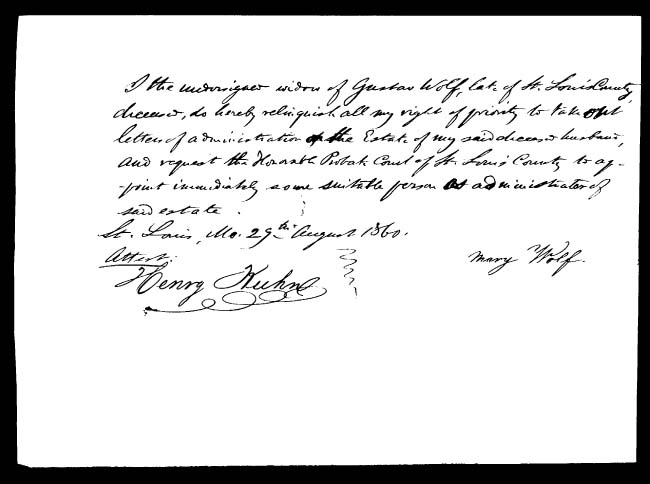
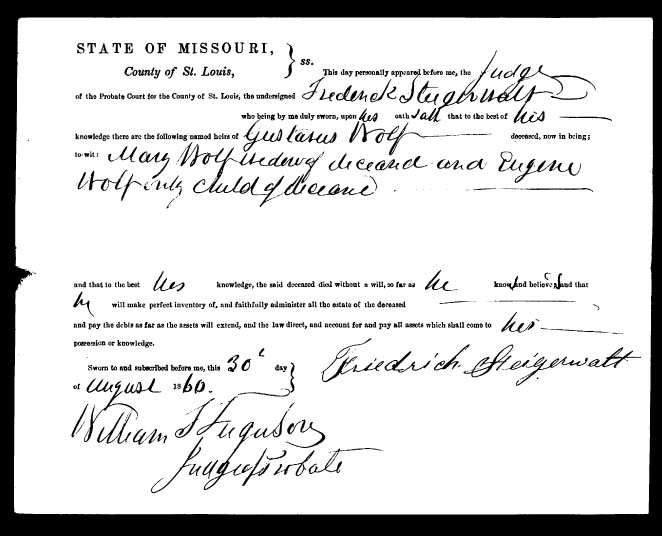
The probate court records related to Gustav's death open with a petition, written and signed on August 29, 1860 by Mary Wolf, "Widow of Gustav Wolf," asking the court to appoint someone to manage the estate of her dying husband.
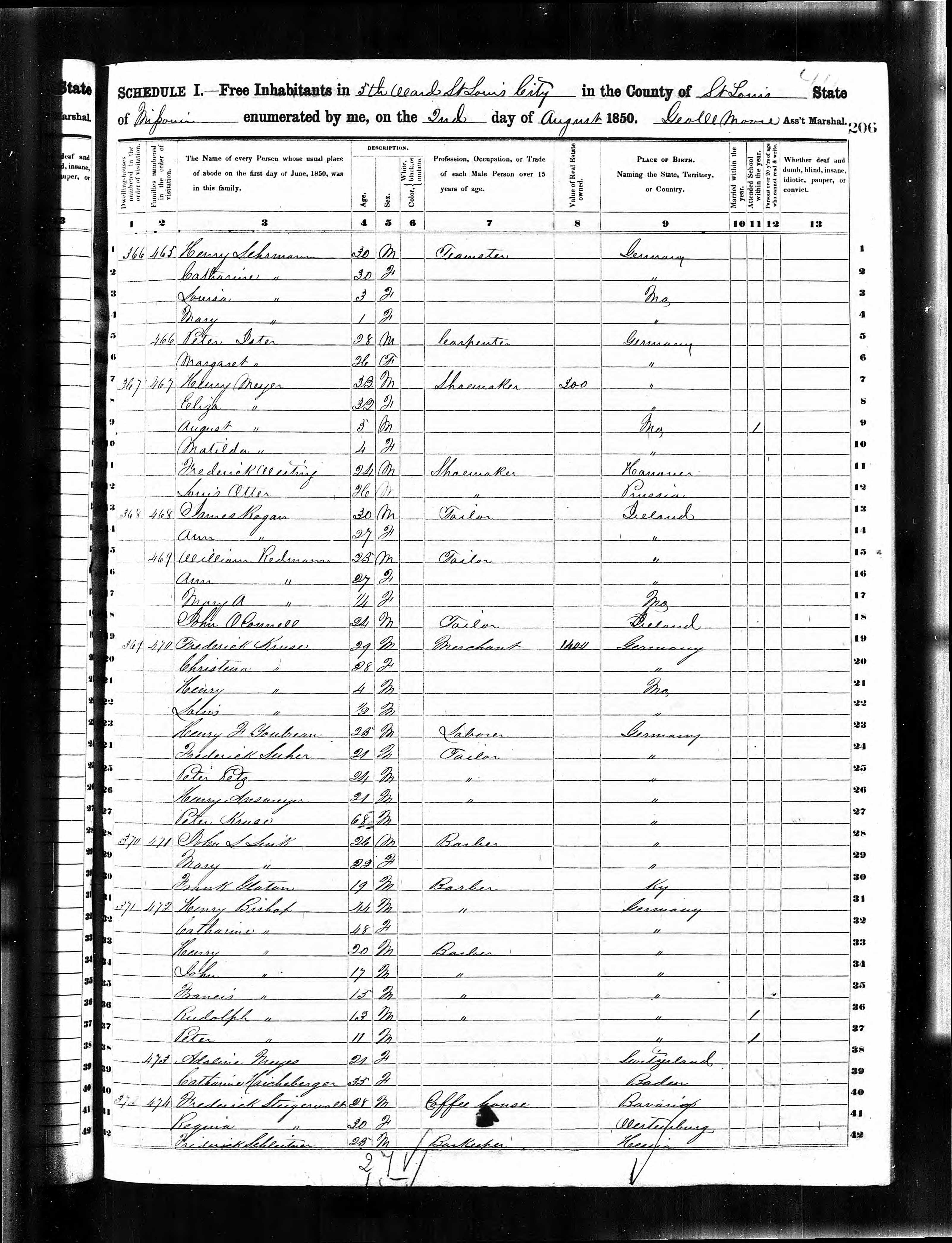
This task was assigned to a fellow contributor to the St. Louis hospitality industry, Frederick Steigerwalt. Immigration records indicate that Steigerwalt first arrived in St. Louis in 1849. On November 17 of that same year, he married Regina Kaes. The 1850 census lists him, age 28, as a native of Bavaria and the owner of a "coffee house." The only other members of the Steigerwalt household listed are his wife, Regina (age 30, from Württemberg) and a 23-year-old "barkeeper" named "Friderick Schleitner" from Hesse. The St. Louis city directories first mention Steigerwalt in 1852, as the proprietor of a coffee house on the south side of Franklin Avenue between Fifth and Sixth Streets. By the time the next city directory (1853-1854) was published, Steigerwalt's coffee house had moved to 25 Market Street and he had taken on a partner identified only as "Kuebler." This is Charles C. Kuebler (1810-1858), the stepfather (see below) of Gustav's wife, Mary Kuebler. The 1850 census identifies him as a 40-year-old "keeper of coffee house" in St. Louis' Third Ward. His household included a wife named Louise (age 38) and three children: Mary [Louise] Kuebler (age 12, of Germany), Christian [Daniel] Kuebler (age 8, of Alabama), and Gustave [Friederick] Kuebler (age 1, of Missouri). Two other non-family members are listed as well: Francis Wittee (24), "Bar keeper" and Henrietta Heck (23), whose occupation is unspecified. Charles Kuebler's name graces a number of city directories, beginning in 1847. At that time he had a "coffee house" at 31 S. Main, a business that moved to the northwest corner of Second and Walnut sometime before 1851. By 1852, Kuebler is listed as the proprietor of a saloon on the northeast corner of Second and Myrtle. The 1854-1855 directory, which is the first to refer to a joint "Kuebler-Steigerwalt" business venture, identifies it as the "Social Hall Saloon" at 25 Market Street. It lasted until 1857, at which point Kuebler assumed sole ownership of the business, and Steigerwalt opened another coffee house on the northeast corner of Fourth and Morgan. The city directory of 1859 (the only one to list Gustav Wolf's hotel, restaurant, and saloon) has no listing for Kuebler (who, as we shall see, had died the previous year), but names Steigerwalt as the owner of an "Oyster Saloon" at 47 Morgan, a business that lasted long enough to be included in the 1864 and 1865 directories. These details help us understand why Friederick Steigerwalt was the selected to manage Gustav's estate. As a former business partner of Gustav's father-in-law, he would have been familiar with Gustav's business ventures, and he would have been trusted by Gustav's young widow. At the time of Gustav's death, Steigerwalt was already managing the estate of Mary's father, Charles C. Kuebler, who passed away only two years before, on July 21, 1858. Unlike Gustav who died intestate, Kuebler prepared his will a few weeks before his death. In he, he divided his entire estate between his three children, the first of them being "my step-daughter Marie Louise, wife of Gustav Wolf." The will went on to name Gustav as its co-executor alongside Frederick Steigerwalt. The pertinent paragraph of the will reads:

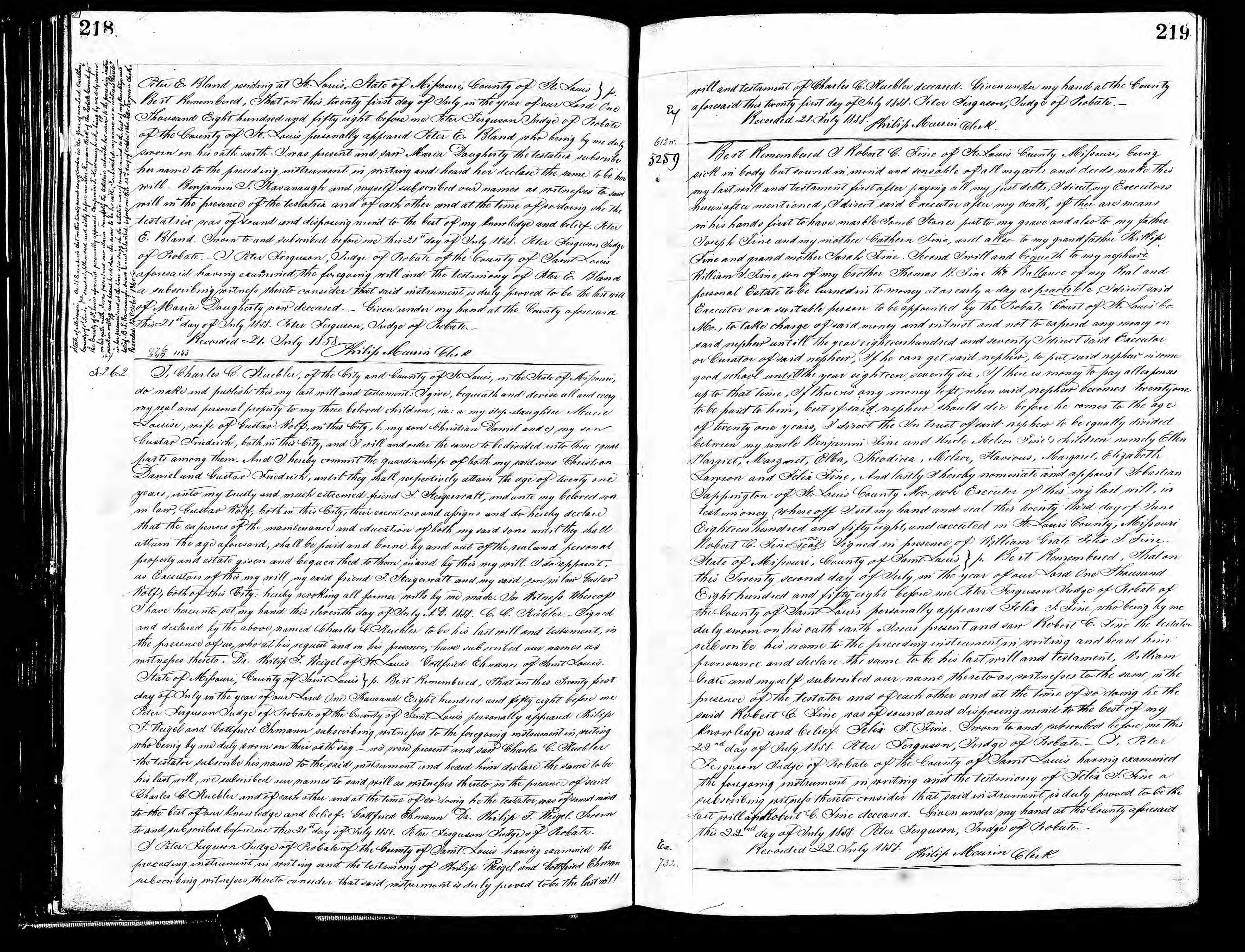
I, Charles C. Kuebler, of the City and County of St. Louis, in the state of Missouri, do make and publish this my last will and testament: I give, bequeath and devise all and every my real and personal property to my three beloved children, viz: a) my step-daughter Marie Louise, wife of Gustav Wolf, in this City, b) my son Christian Daniel, and c) my son Gustav Friedrich, both in this City, and I will and order the same to be divided into three equal parts among them. And I hereby commit the guardianship of both my said sons Christian Daniel and Gustav Friedrich, until they shall respectively attain the age of twenty one years, unto my trusty and much esteemed friend F. Steigerwalt, and unto my beloved son-in-law, Gustav Wolf, both in this city, their executors and assigns; and do hereby declare that the expenses of the maintenance and education of both my sons until they shall attain the age aforesaid, shall be paid and borne by and out of the real and personal property and estate given and bequeathed to them in and by this my will. I do appoint as executors of this my will my said friend F. Steigerwalt and my said son-in-law Gustav Wolf, both of this City: hereby revoking all former wills by me made. In witness thereof I have come hereunto set my hand this eleventh day of July, A. D. 1858. C.C. Kübler.
Knowing that Mary Kuebler was the step-daughter of Charles C. Kuebler allows for some informed speculation with regard to the blank spots in Gustav's biography between his arrival in St. Louis in 1853 and his debut in the local press at the end of April, 1857. It seems likely that Gustav found work in one of Kuebler's or Steigerwalt's businesses, perhaps the "Social Hall" saloon that they owned together. There he would have met Mary, seven years his junior. The two were married sometime in 1857, at which point Kuebler would have begun assisting his new son-in-law in the launching of his own business. Hence the reference, in the inventory of Gustav's property, to "An Indenture of Lease made by C. C. Kübler to Ernst Müller and Alvis Reinhardt, dated 24th April 1858, and by them assigned and transferred to Gustavus Wolf, by endorsement on said Indenture, dated 24th June 1858." This transfer occurred less than a month before Kuebler's death, suggesting that he was setting up Gustav and Mary in an effort to keep the family business going; his two sons, aged sixteen and nine at the time of his death, were still too young to assume that kind of responsibility. The confidence that Charles had in his son-in-law is also evidenced by the role Gustav played as co-executor of the estate alongside Frederick Steigerwalt. Gustav's signature is present on number of the documents included in the probate records for Charles. It is interesting to note that Gustav purchased a number of items at the Steigerwalt estate sale (an event that he, as an executor, helped to organize), held on October 20, 1858 "at the NE corner of Morgan and Fourth Streets." For the record, Gustav ended up with: "1 gold pen holder, 2 gold finger rings, 1 set (3) gold studs, 1 gold watch, 1 vol. 'History of the Inquisition in Spain' in German, 2 brass candlesticks, 1 oil painting (landscape), 1 alpaca coat (black), 1 cigar [xxx] and money purse, 1 silk umbrella, 1 syringe." Little did Gustav know that he would have little time to enjoy these items.
Before turning to Gustav's probate records, let us look more closely at his mother, Mary Louise Kuebler. She is the only one of Charles Kuebler's three children who is identified in these documents as a step-child; Charles was the biological father of his sons, Christian Daniel and Gustave Friederick. The 1850 census list Mary's place of birth as Germany, while her brothers are assigned to Alabama and Missouri respectively. Other documents related to her three children confirm her German birth. The only exception in the 1880 census, which identifies Mary as a native of Alabama, just like her half-brother, Christian. The same entry identifies Mary's (unnamed) father as an immigrant from Wuerttemberg. If Mary was born in Germany, her mother Louise and Louise's unnamed first husband must have made their way to Alabama sometime after Mary's birth in 1838. Shortly thereafter, Louise must have lost her husband, met and married Charles Kuebler, and given birth to their Alabama-born son, Christian. This mixed family made their way to St, Louis sometime in the five-year period between the births of the two sons: 1844-1849. That is about all that can be said about Louise, the wife of Charles and mother of Mary Louise, except that she seems to have died in 1855, which explains her absence from Charles' will, drawn up in the summer of 1858. The fact that we know neither Louise's maiden name nor her first husband's name makes it unlikely that we will ever know who Mary Kuebler Wolf's biological parents were.

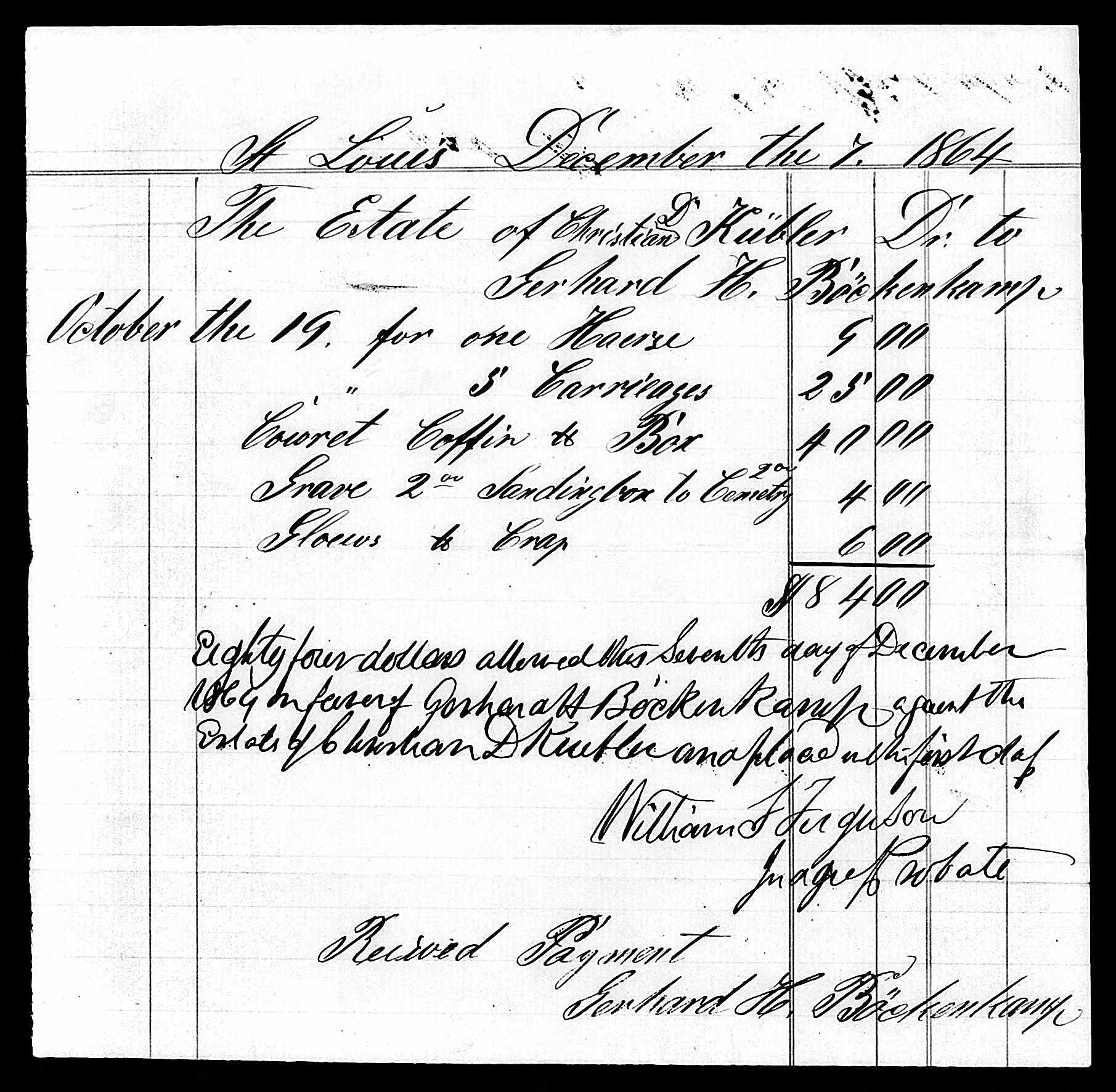
It is of some interest to note here that Christian Daniel Kuebler, the older of Mary's two half-brothers, died young, on October 19, 1864 of Typhus fever and was buried the same day. Not surprisingly, given the fact that Frederick Steigerwalt had handled Charles Kuebler's estate and had been named the trustee for the minors Christian and Gustave, he stepped in once again, this time to handle Christian's estate. Based on the age ascribed to Christian by the census of 1850, he would have been 22 when he died. Yet his own probate records reveal that he had not yet inherited his third of his father's estate, which should have happened when he turned 21. In any case, Christian's younger brother, Gustave Friedrich Kuebler, was named as one of two heirs of his brother's estate, the other being Gustav Wolf's widow, Mary Kuebler Wolf. Because she was only Christian's half-sister, Mary's share of the inheritance was exactly half of Gustav Friedrich's share.



Getting back to Gustav, Steigerwalt was still managing the patrimony of his friend Charles Kuebler on behalf of his two minor sons when he assumed responsibility for Gustav's estate. This entailed preparing an inventory of Gustav's assets and debits, collecting moneys owed to Gustav, and paying off those to whom Gustav owed money. The fact that Gustav has just inherited, my virtue of his marriage to Mary Kuebler, a third of her step-father's estate and had just launched his own new business made this a complicated process.
The documentation related to
the settling of Gustav's estate turns out to be
full of fascinating information. One particularly
poignant document is a request from Gustav's widow
for a one-time allowance of
$182.50 to support her for one year, because "at the time of the decease of her said husband there was no grain, meat, vegetables,
groceries or other provisions on hand." Testifying
to the legitimacy of the request is none other
than Gustav's younger brother, Eberhard Wolf. It
might seem odd that Mary, who had recently
inherited a third of her step-father's estate,
needed this kind of subvention. But in all
likelihood, the inheritance that she and Gustav received
was tied up in the family business, which Gustav
and Mary must have regarded as perfectly consistent with
Charles' entrepreneurial trajectory.
The "Inventory
of all the Real and Personal Estate of Gustavus
Wolf," recorded on September 5, 1860, indicates
that Gustav had secured a three-year lease
(commencing May 15, 1858) at a cost him $1,500 per
year) on a three-story brick house "situated on
the north side of Market Street between Main and
Second streets" on the west side of the alley that
ran between Market and Chestnut Streets. This
description fits what we learned above from St.
Louis Directory: that Gustav ran a hotel and
restaurant at 23 Market Street and a saloon as 56
S. 2nd Street. But the inventory is more precise,
indicating that Gustav had sublet the hotel that
occupied the upper floors to Christian Fluhr
beginning June 1, 1860. As noted above, it is likely that
Gustav's physical condition was deteriorating and
he felt the need to take on a partner to run part
of the business. The inventory further shows that
Gustav was the owner of "six lots of ground" along
Pennsylvania Avenue, property that he had
purchased on May 21, 1858. It is not clear what he
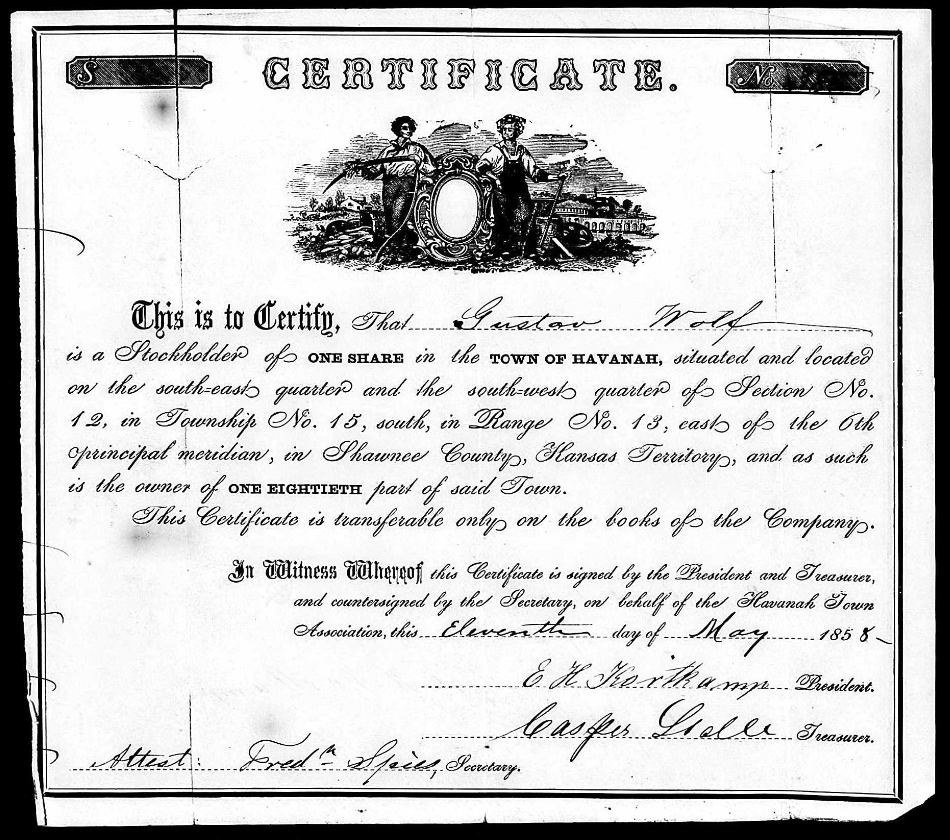
intended to do with this real estate. As it turns out, Gustav's investments
were not confined to St. Louis. He also bought a
share stock in
the town of Havana, in Shawnee County, Kansas
Territory, entitling him to "one eightieth part of
the said town." This investment, made on May 11,
1858, was connected to the creation of a stage
coach stop in Havana, a development
 that could have made the remote settlement an important stop on
the Santa Fe Trail. Havana did end up attracting some fifty
German and French families as settlers. But in the
end the settlement failed and was abandoned
altogether in early 1870s. The remains of the
station and hotel are today commemorated by a historical marker on
Kansas State Highway 31 not far from Burlingame in
Osage County, Kansas.
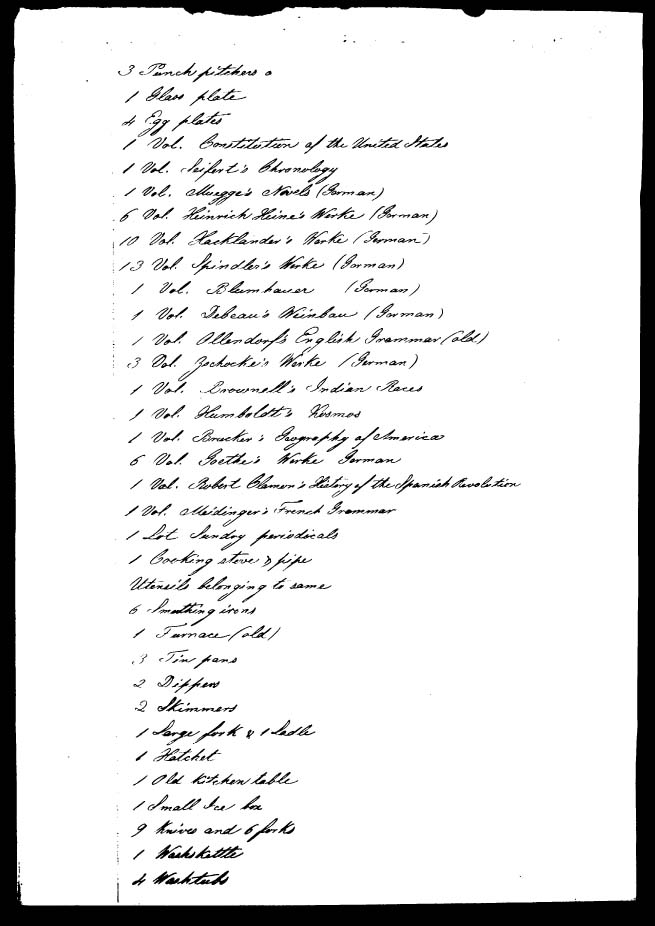
The official inventory of
Gustav's moveable property is a remarkable, if
banal, piece of social history since it reveals
precisely what a hotel owner and restauranteer in
St. Louis in 1860 required to run such a
business. Of particular interest is the selection
of beverages, including not only the usual
whiskeys, brandies, and other hard spirits, but a
wide variety of wines by the barrel: Haute
Sauterne, Catawba (from Germany as well as
Cincinnati), "Rhine wines" (including Hochsteiner,
Durchheimer, Feuerberger, Ungsteiner, Forster
Rieslinger, Wachenheimer), and two forms of
"Neckar wine," which of all his wines would have
reminded him most of his youth in Plochingen. No
beer is mentioned in the inventory, but the list
does include twenty beer mugs. Food items are not
as well represented as drink in the inventory,
though there are plenty of
 references to the implements necessary to hold or
prepare them, including a pewter cracker box and a
"cabbage plane," used to make coleslaw. The fact
that Gustav had 1,750 cigars in stock when he died
(along with the accumulation of seventy-seven
empty cigar boxes) testifies to what his
customers liked to do when they drank. Two chess
boards and two sets of dominoes round out the
entertainment options. Whether intended to be used
by his clients or simply a part of his own
personal property, Gustav's small library reflects
his immigrant status and his father's career as a school teacher.
Among the German
titles, which constitute the majority of the
collection, were the works of contemporary authors
such as Heinrich Heine (1821-1881) and Friedrich
Wilhelm von Hacklander (1816-77), as well as
recently deceased ones like Heinrich Zschokke
(1771-1848) and Johann Wolfgang von Goethe
(1749-1832). The handful of English titles
bears witness to an immigrant's effort to manage
his new environment: Brucker's Geography of
America, Brownell's Indian Races
(1857), Allendorf's English Grammar, and
the Constitution of the United States. One title
missing from this inventory is the German-language book on
the Spanish Inquisition, which we know Gustav
purchased from the estate of his father-in-law.
The total estimated value of all of Gustav's
moveable goods: $2227.66.
Gustav Friedrich Wolf's Siblings in St
Louis
The 1860 census describes
Gustav's youngest brother, Eberhard Ludwig
Wolf, as a 26-year-old cabinet maker from
Metzingen, Wuerttemberg, married to Louise, a
25-year old immigrant from Fellbach, Baden. The
couple had four young children: Fred (6), Charles
(5), Wilhelm (3), and Louise (1). The first three
were born in Philadelphia; only Louise was
a native of St. Louis. Remember that Eberhard's naturalization process (which culminated in St. Louis in the month of August, 1859) required that he be a resident of Missouri for at least one year before he could be granted citizenship. That means that Eberhard must have relocated no later than the summer of 1858 (and not much before).
Eberhard's new life in St. Louis was interrupted by the the Civil War, which officially began with the
shelling of Fort Sumter on April 13, 1861.
Pension
records indicate
that Eberhard served in Company F of the 2nd Regiment of
the U.S. Reserve Corps (Infantry) and Company D of
the 5th Regiment of Missouri (Infantry). Neither
the exact date of his enlistment nor that of his
death is known, but we do know from the St.
Louis Marriage Index that his wife Louise
married again on June 16, 1864, this time to a man
named Charles Hauser.51 Louisa's remarriage is
corroborated by her and her children's appearance
as "Hausers" in the 1870 census. There Louise Hauser is indentified in the as a 35-year-old "washwoman," originally from Baden,
Germany. "Fred" is listed as a 16-year-old brush
maker and Charles, a 15-year-old errand boy.
"Will," age 13, and "Louise," age 11, round out
the list of formerly Wolf children. Mr. Hauser, who must
himself have been dead by the time of this census
given the absence of his name from the entry, had added
two children of his own to the family: Dina and
Alex, age 9 and 5 respectively. These two, like
young Louise, were born in Missouri; the four
older children were, as already noted, natives of
Pennsylvania. Judging from the list of jobs held
by Louise and her two oldest boys, life for the
Wolf-Hausers after the war was not easy. Twenty
years later, we find Louise Hauser filing for
Eberhard's pension (June 5, 1890). Her death on
February 21, 1891 opened the door for her married
daughter, Louise Wolf Wahl, to claim the
pension for herself on June 14, 1891.52
Wilhelmine "Minna" Wolf, the second oldest of the Wolf immigrants, was 21 when she crossed the Atlantic in June, 1854. In was in St. Louis that she met and married Henry Kuhn in July 1858. It was Henry who ended up witnessing and signing the court petition with which his sister-in-law, Mary Kuebler Wolf, authorized Frederick Steigerwalt to handle Gustav's estate. We happen to have a loving note in Henry's hand, written to his Wiebchen ("little wife") on February 19, 1861. Sometime before 1870 Henry died, but not before giving Minna a baby boy named James. The appropriate entry in the census records of 1870 indicate that James was seven at the time, suggesting a birthdate of 1863. This is contradicted by local death records, stating that a "Henry Kuhn" died in St. Louis on February 18, 1862. 53 If, as seems likely, this is a reference to Minna's husband, then James could not have been born any later than November, 1862, making him eight rather than seven at the time of the census. In any case, the census of 1870 finds "Minna Kuhn" (age 38) living in Washington, Missouri, about sixty miles due west of St. Louis, with her son James (7) in the home of Alex Brunner, a Bavarian-born "bar keeper" for whom Minna kept house. It would appear that the widowed Minna and her son had moved in the wake of Henry's death so that they could live near Minna's brother Wilhelm/William (see below). Ten years later, according to the 1880 census, we find Minna back in St. Louis living with her brother Gustav's widow Mary, who had since remarried a man named John Fehlmann (see below). 54 When the 1900 census was taken, Minna was living in Pacific, Missouri (twenty miles southwest of St. Louis) with her widowed sister (see below), Amalie Louise Geister (age 60, a "nurse") and her unmarried daughter Minnie (age 31). Minna died in Pacific on March 13, 1912, at age 79. On her death certificate she is described as a German-born housekeeper and widow who died of diabetes.
Wilhelm/William
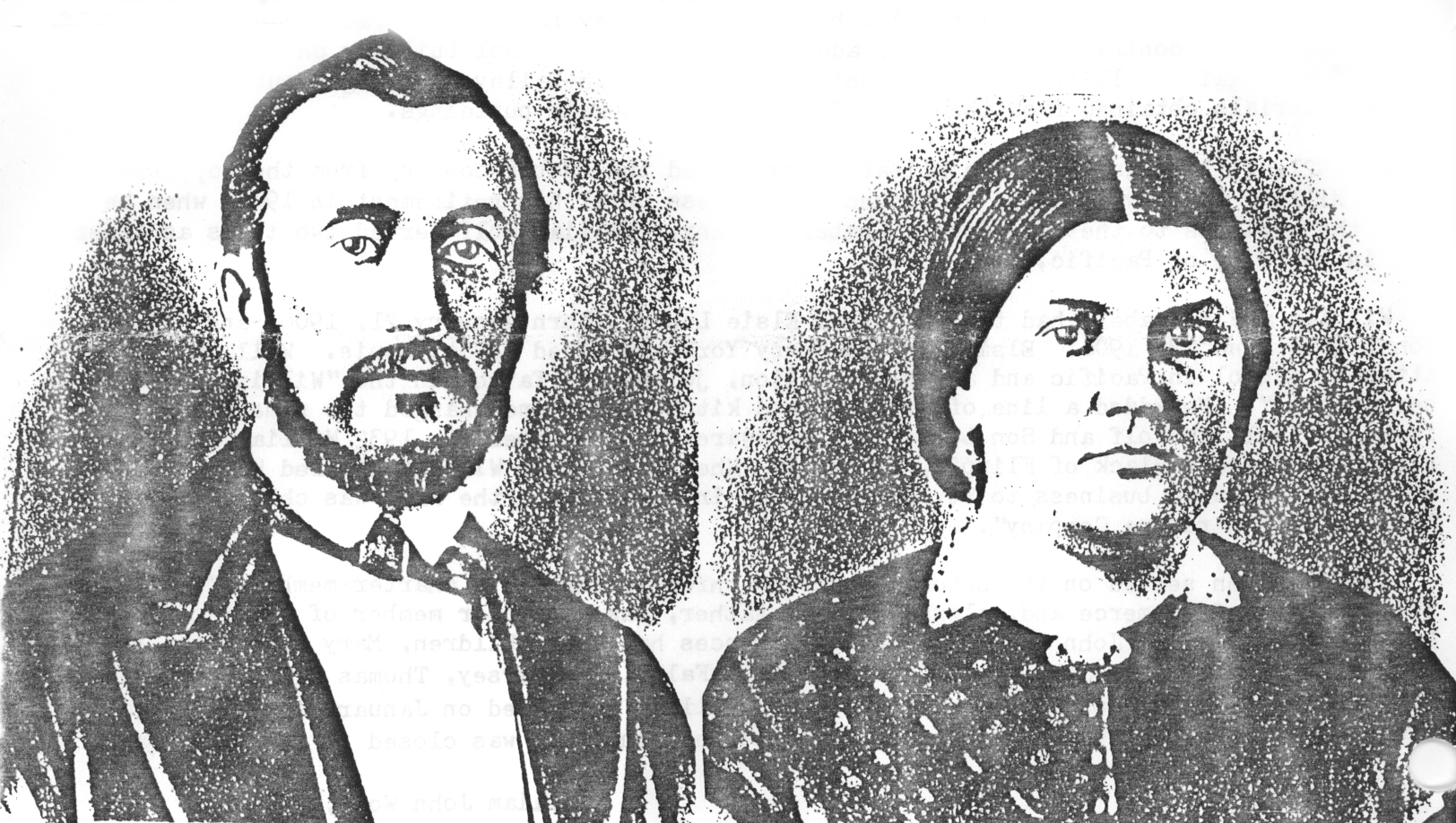
Wolf appears in the St. Louis
Directory of 1859 as a boarder with the same
address as Gustav's saloon. About four years
later, William married a young widow with similar
Württemberg roots named Mary Seifert
Fausel. When her first husband, William
Fausel, died in 1862, Mary was already the mother
of four children--Pauline (b. 1855),
Herman (b. 1857), Caroline (b.
1859),
 and George (b. 1861). After marrying
William Wolf, Mary gave birth to five more children. By the
next census
(1870), William and family were living in
Washington, Missouri, where William is identified
as a 39-year-old "hotel keeper." With him and his
wife Mary (age 30) lived not only Mary's four
children from her previous marriage (ages 15, 13,
11, and 9), but the three surviving ones of their
own: Bertha Wolf (age 6), Mary
Wolf(age 4), and William Wolf (age 2).
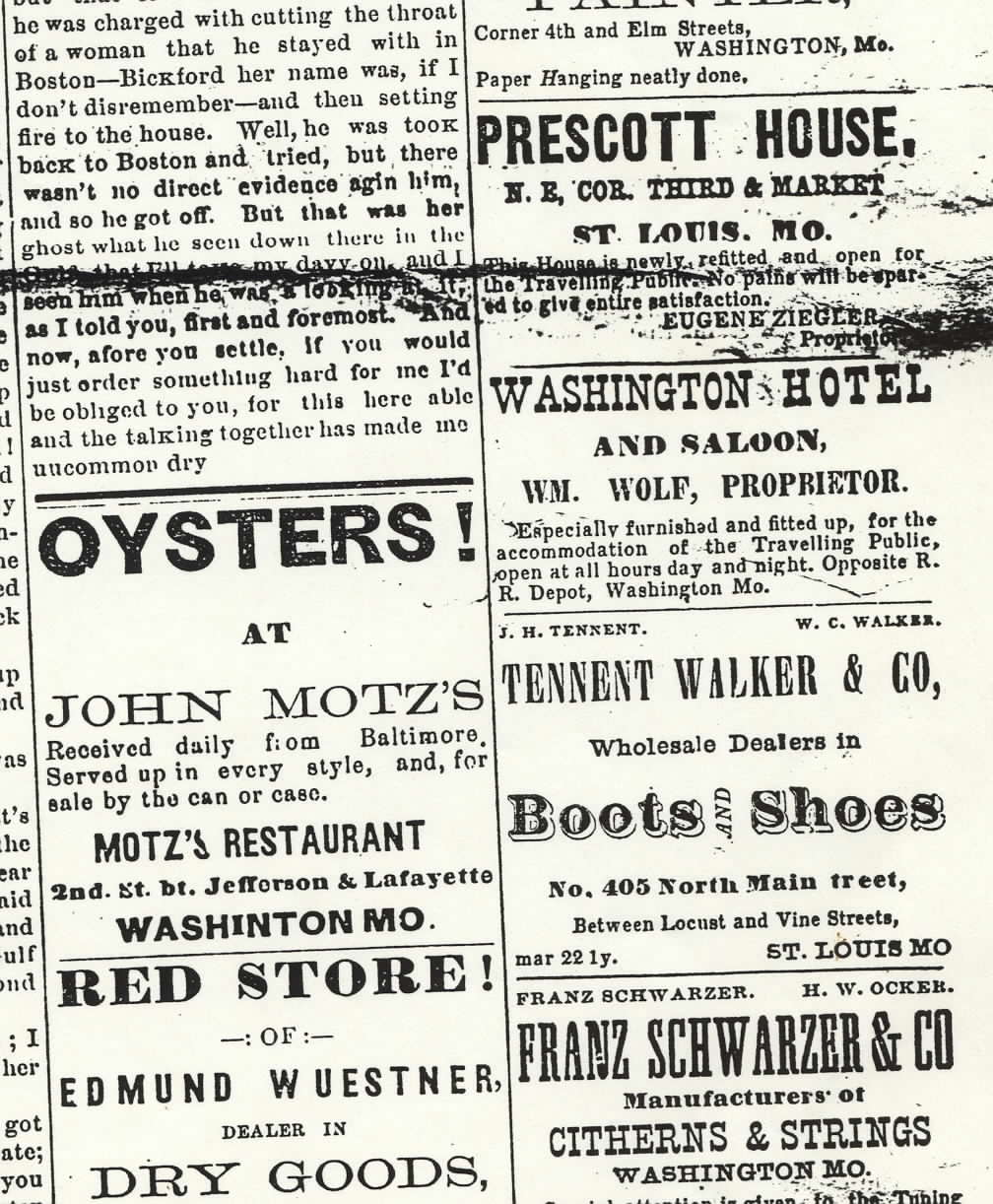
A local newspaper (3/14/1873)55 contains an advertisement for the
"Washington Hotel and saloon, Wm Wolf,
Proprietor." The ad describes the Wolf hotel as "especially furnished and fitted up, for the accommodation of the travelling public, open at all hours day and night. Opposite R.R. Depot, Washington, Mo."
 William's and Mary's lives in Washington,
Missouri, were marred by personal tragedy. Beyond
the two of their children (Gustav and
Heinrich) who died in infancy, a third one (Mary)
died at age 16 after her dress caught on fire
while she was cleaning the hearth. As if this were not enough, both
William and Mary died of pneumonia in 1876, when he was only 45 and Mary 36. Their two youngest
surviving children, Bertha (age 12) and "Will" (age 8) moved
in with their aunt Amalie Louise Wolf Geister (see
below) in Pacific, Missouri.56 Both of them would marry
and contribute five children to the next
generation.57 Will and
his wife Betty would actually live to see their
golden wedding anniversary, a feat acknowledged by
Will's cousin Helen Wolf Ernst, the daughter of
Eugene (see below) in a letter dated July 24,
1947.58
Amalie Louise (a.k.a.
Louisa) Wolf, the youngest of the Wolf immigrants,
married Valentin Geister
(8/7/1829--9/8/1884), another German immigrant, on
May 16, 1864, in St. Louis.59 The two of them moved to
Pacific, Missouri a short time later and had their
only child, a daughter named Minnie
(6/5/1865--8/28/1950). Minnie was eleven when her
orphaned cousins Bertha and Will came to live
with her family. The 1880 census
identifies Valentine Geister as a 51-year-old farmer in
Pacific, living with his wife Louise (age 40),
his daughter Minnie (age 15), and his nephew
William Wolf (age 12). For some reason there is no
mention of Bertha, who would have been 16 years
old at the time. Valentine died only four years
later, in September 1884. Will Wolf
stayed with his Aunt Louise up to the time of
his marriage to Betty in 1897. Amalie Louise remained in
Pacific until she died on January 19, 1926 at age
85. Minnie Geister, her only child, never married.
The Eugene Wolf Family
As we saw above, Eugene Wolf
(8/23/1859--7/30/1901), the only child of Gustav
Wolf and Mary Kuebler Wolf, completed his first year of life the very
day his father died. He was fifteen when
his widowed mother married a Swiss
immigrant named John Fehlmann
(8/4/1832--11/24/1904) on March 31, 1875. Like his
new wife, Fehlmann had been married before.
In fact his first wife, Margaret
Steigerwalt, whom he married on March 6 1864,
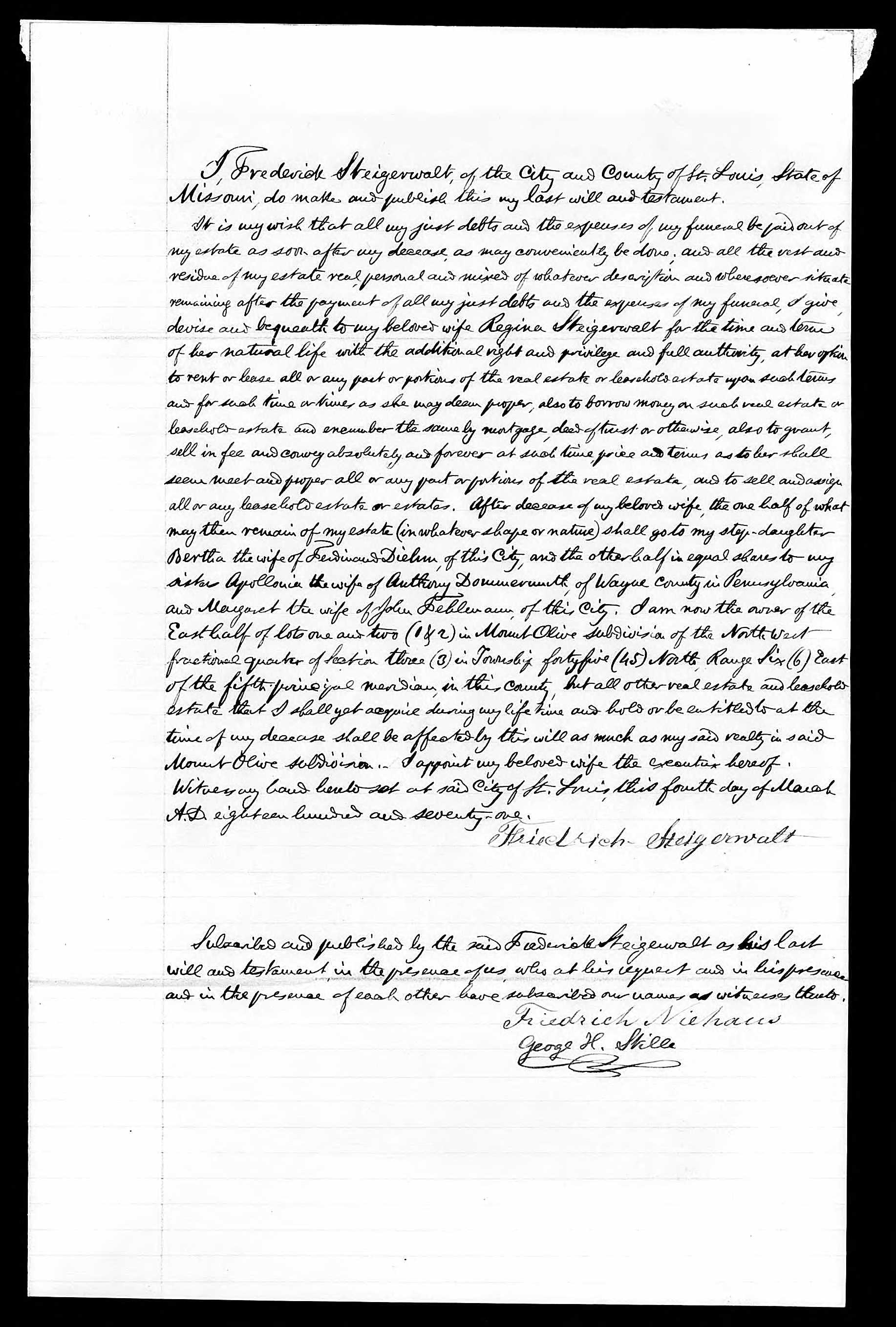
was the sister of Frederick Steigerwalt, who (as we saw above) handled the estates of Gustav Wolf, Charles C. Kuebler, and his son Christian. This relationship is
confirmed by Frederick's will (march 4, 1871), where he names as secondary heirs his step-daughter, Bertha, and his two sisters, Apollonia and Margaret, the latter identified as "the wife of John Fehlmann." It is worth noting here that John Fehlmann had served (seven years before) as one of the two "securities" for Frederick Steigerwalt, the "principal" in the handling Christian Kuebler's
estate in October 1864. 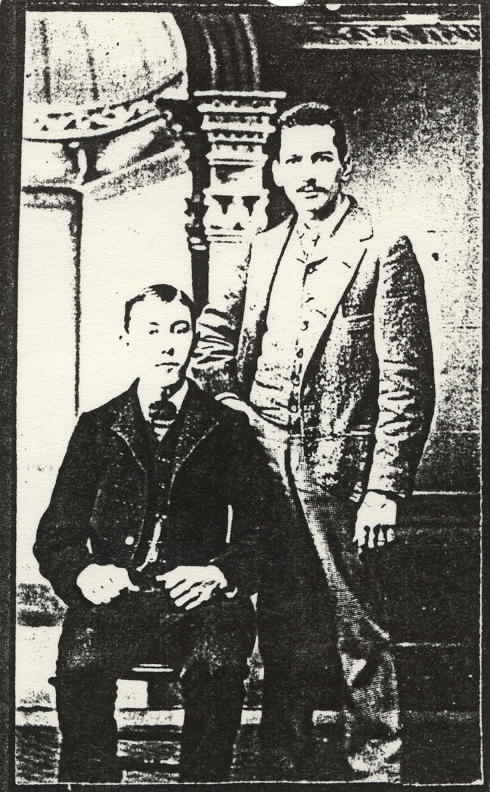 Anyway, John
Fehlmann and Margaret Steigerwalt married on March
6, 1864 and had three children in quick
succession: Adolph Kuebler
(3/7/1865--2/2/1946, Mary Kuebler (b.
4/1/1866), and Anna Kuebler (b. 1868). In
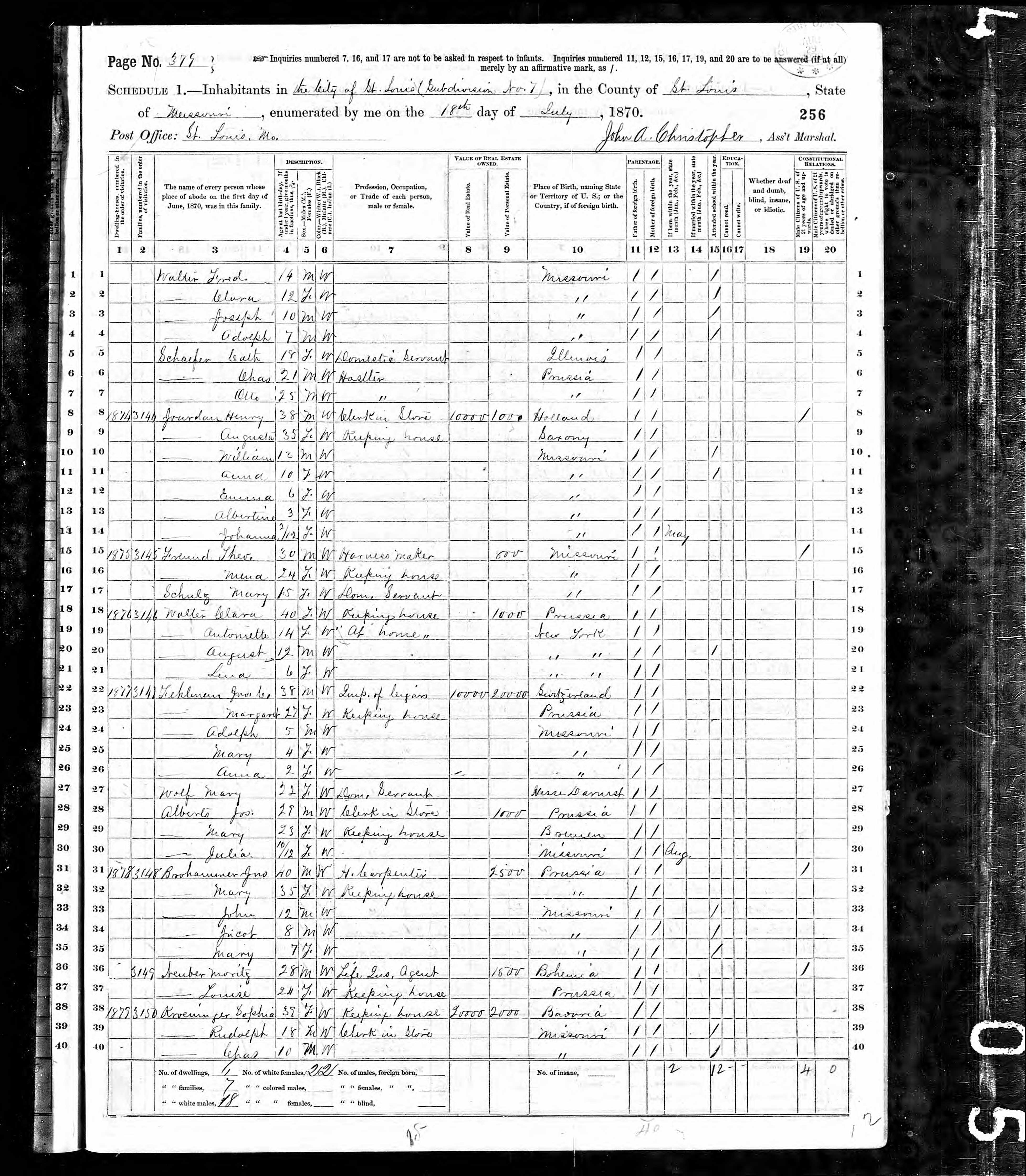
the 1870
census, John is listed as an 38-year-old
"importer of cigars" from Switzerland. His wife
Margaret, 27, responsible for "keeping house," is
from "Prussia." Adolph (5), Mary (4), and
Anna (2) are all listed as products of Missouri.
Margaret died on December 24, 1873 and fifteen
months later John married the widowed Mary Kuebler Wolf.
[Note that at this point Mary began using the German spelling of her name (Marie), perhaps because her new husband preferred it.] The
newly blended family appears in the 1880 census, with
John listed as a 47-year-old "cigar dealer" in St.
Louis, supporting his wife "Marie" (age 43, from
"Alabama"), her son Eugene (age 20), and
three of John and Marie's own children:
Adolf (age 15), Marie (age 14), and
Anna (age 12). By then Eugene, identified
as the "stepson" of the "head of the household,"
was working as a bookkeeper for a pulley company.
He seems to have begin pursuing this career at
age 18, appearing in the 1877 edition of the
St. Louis City Directory
as an "assistant bookkeeper" for the U.S. Savings
Institution. The only other person listed in the census as part of the
Fehlmann household is "Minna Kuhn," identified as
a "sister-in-law" of John Fehlmann, even though she
was actually Mary's sister-in-law (see above). The
1900 census
has John and "Marie L" Fehlmann still living in
St. Louis, ages 68 and 62 respectively, with John
still plying his trade as a "cigar merchant." Four
years later, on November 24, 1904, John passed
away. According to the entry in the St. Louis Register of
Deaths, the death occurred at 927 Morrison
Ave. in St Louis, presumably the family
home.
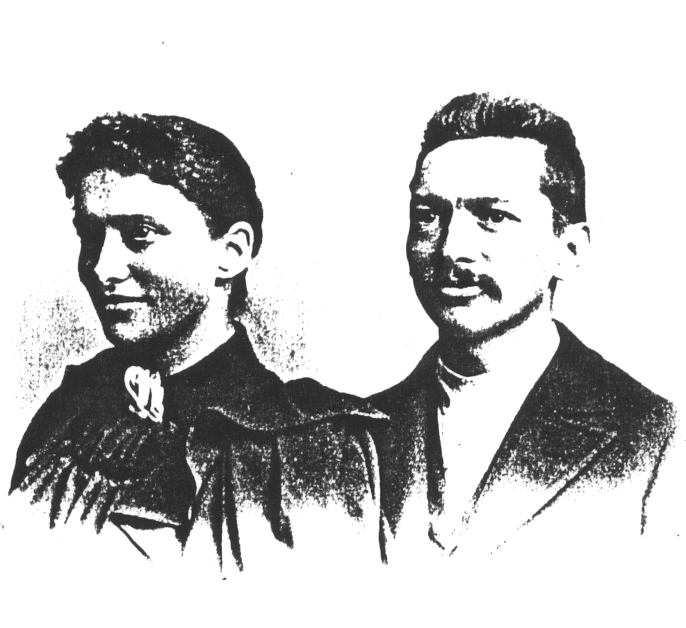



On
July 20, 1883, Eugene, age 23, married Clara Bremermann
(8/23/1863--10/15/1916), age 19, in the town of Greenleaf
Kansas, some 400 miles west of St. Louis. Why the marriage was celebrated there rather than in St. Louis is not clear. Clara
was the daughter of Gerd Bremermann, a
prosperous merchant who had immigrated from
Bremen, and Johanna Clara Briegleb (m.
4/20/1844 in St Louis).61a
[Bremermann, Briegleb, and
Bartenstein lines] Eugene and Clara would have
four children over the course of their first eight
years of marriage, all born in St. Louis. Sadly,
the first, Robert Gerard Wolf, died when he was only five days old (on June
12, 1884). The St. Louis Registry of Deaths lists his cause of death as "Trismus Neonatorum," a form of lockjaw. The other
three children, all of whom lived long lives, were:
Helen Clara Wolf (June 1885--1957),
Marie Louise Wolf (2/3/1887--5/16/1964),
and Walter Richard Wolf
(10/9/1891--1/25/1969).
Unfortunately for his young
family, Eugene contracted tuberculosis, a disease
that presumably prompted the family's relocation
to Colorado in 1893. Tuberculosis was a veritable
scourge of nineteenth-century
American cities, responsible for one in five
deaths in the United States in the first half of
the nineteenth century. Though the incidence of
the disease declined somewhat in the second half
of the century (accounting for one eighth of the
deaths in the 1880s), it was still a specter that
haunted American society well into the twentieth
century. 54 We have a letter that Eugene
wrote from this address to his cousin "Will" Wolf
on June 21, 1897. In the letter Eugene
congratulates Will on his upcoming marriage to
Betty and refers in passing to his own "broken
road of health."62 His
illness would prevent him from joining his wife
Clara on her trip to see the newlyweds the
following month.63
Sometime in 1898 the family moved to 2933 Gilpin
St., and Eugene began working for
the L. Anfenger Agency Company. The 1900 census, the
last one to include Eugene as the head of
household, lists him as an "accountant" living on
Gilpin St. with his wife and three school-aged
children. The census takers found the Wolf family
still intact in June of that year. The City
Directory of 1900 indicates that Eugene worked as a clerk for Schirmer Insurance
& Investment Company (1900). It was in this capacity that, on August 30 of that year,
Eugene gained a bit of notoriety . According to
the report in The Rocky Mountain News that ran the following day,
Eugene was visited around noon by a well-dressed man who invited him to step outside
the office on Sixteenth Street to discuss a business matter with his associate, who was waiting for him with his horse and buggy on the street.
While Eugene was engaged in conversation with him, the first man made his way
back into the office and forced open the cash drawer,
making away with $98.30. The two casually made their getaway in the buggy, their heist remaining undiscovered until after they were gone. Eugene notified the police but to no avail; "The description given of them does not tally with that of any crook now sojourning in the city." Despite this incident, Eugene remained employed at the company through the first half of 1901. On July 30 of that year he died at age 41. A "card of thanks" published in the same newspaer on August 5, reads: "We wish to extend thanks to friends who took such [a] kind interest in [the] sickness and death of Eugene Wolf." signed: Mrs. Clara Wolf and Mr. Mary Fehlmann.  According to the city
directories (1893 and 1894), Eugene's last job in
St. Louis was as a "clerk" at Charles H. Gleason &
Company, and his first position in Denver was as a
bookkeeper with Dunn & Blass Leather Company. The
first address for the Wolf family in Denver was
2950 Williams Street, but by 1897 they had moved
to 3060 Josephine St. It turns out that tiny two-bedroom home was built in 1896, so in all likelihood, the Wolfs were its first owners.
 Before Robert Koch's discovery of the Tuberculosis
bacillus in 1882, the general medical consensus
was that the disease was hereditary and chronic,
not contagious. Consistent with such mistaken
ideas about the disease was the tendency on the
part of nineteenth-century physicians to prescribe
little more than changes in routine designed to
remove the environmental "irritations" that they
imagined might exacerbate the symptoms. Men of
Gustav's time who were well-off would have been
advised to spend time in what were considered
cleaner, more therapeutic environments: the sea,
the islands of the Caribbean, or the new lands of
the western frontier, including Colorado, Arizona,
New Mexico, and California. Men with more
obligations than means--and women of all social
ranks--tended to stay home and make the most out
of what little could be offered them in the way of
treatment. Since it was not uncommon for people
who had contracted the disease to live for years
or even decades after the symptoms first appeared,
most simply went on living their lives as best they could,
marrying, having children, and pursuing their
careers. Eugene's own bout with the
disease would last eight years after the
family's move to Colorado.
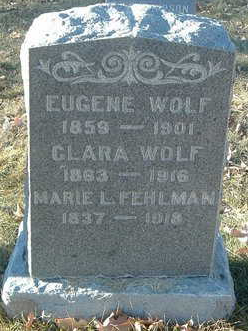 Eugene finally succombed to tuberculosis on July 30, 1901, less than a month before he would have turned 42. A few days after his death, his widow "Clara Wolf" and his mother "Marie Fehlmann," co-signed a "card of thanks" published in The Rocky Mountain Times: "We wish to extend thanks to friends who took such kind interest in the sickness and death of Eugene Wolf" [RMN Aug 5 1901]. Eugene was buried in Denver's Fairmount
cemetery. His wife Clara, who is not
given an occupation in the 1900 census, became a
school teacher and continued to raise their three
children in Denver until her own death in 1916.
The 1910
census identifies her (age 45) as the head of
a household at 3234 Marion St. that included her
daughter Marie (age 22) and her son Walter (age
19); Clara's oldest daughter Helen (age 24) had
already married by then, though she, her husband,
and her young son lived right next door (at 3136
Marion). All three members of the Clara Wolf
household were working at the time: Clara as a
public school teacher, Marie as a stenographer,
and Walter as a clerk in a seed company. On
October 18, 1916, Clara Bremmerman Wolf died and
was buried next to her husband in Denver's
Fairmount Cemetery. Less than two years after
that, on March 16, 1918, Marie Kuebler Wolf Fehlmann passed away and was laid to rest next to the bodies of
her son and daughter-in-law. 64 Marie's death certificate
indicates that she had resided in Colorado for
eight and a half years before she died. That means
that she moved to Denver from St. Louis in 1909,
five years after her husband John Fehlmann's died.
Helen, Marie, and Walter thus got to know their
grandmother well, calling her "Grossmama,"
one of the last few traces of spoken
German in the Wolf household. 67 It is likely that Clara
was the original source of the Christmas cookie
recipes that have made their way down through the
succeeding generations of the Wolf family.

Eugene's three children,
born in St. Louis but raised in Denver, ultimately
followed very different paths. Helen Wolf married
a Texas-born accountant by the name of Louis
William Ernst (9/5/1879-6/5/1970) in 1908. He
was the son of Charles W. Ernst and Joanna Hannah
Lamers. Helen and Louis
Helen's younger sister Marie
Wolf--who, according to the 1920 Census, moved in
with her sister after their mother's death--used
her share of the inheritance to go to New York.
She returned to Denver in 1929 with her friend
Helen Althouse (a.k.a. Trigg) and took a job as an
advertising manager at the bank where she had
worked before she left for New York. But Helen
Althouse, who was originally from California,
wanted to return to the "Golden State" and Marie
followed her in the very early 1930s, living in
Los Angeles for the rest of her life. At one point
Marie owned a bookstore in Eagle Rock (at 4121
Eagle Rock Blvd.), which would have catered to the
needs of Occidental College students, among
others.69 Her California
nephews and nieces (Walter's children; see below)
got to know Marie well as they were growing up,
referring to her affectionately as "Auntie Me."70 Gene Ernst remembered his
Aunt Marie as a wonderful story teller, an amateur
actress, and an avid sportswoman who enjoyed
mountain climbing and tennis.71
Walter Richard Wolf seems to have used his
share of his grandmother's estate to finance his
relocation to California in 1920.
Four years earlier, Walter had married Helen Cary Keyt
(7/24/1894--7/25/1963), the daughter of William
Baxter Keyt (3/16/1860--8/2/1911) and his
second wife, Gertrude Gardner Grubbs
(5/29/1860--4/8/1945). Helen had a younger brother
named Thomas ("Tom") Grubbs Keyt
(3/24/1902--11/20/1958) 72.
[The Keyt, Degolyer, and
Grubbs lines] Helen Keyt was actually engaged to a local
banker named Kent Whitman when she first met
Walter. According to family lore, one day Walter
Wolf came to the Keyt house and, upon seeing Helen
coming down the stairs, addressed her as "my dear
little girl." That bit of gallantry seems to have
made a deep impression on Helen, who ultimately
called off her engagement to Whitman.
[Helen Cary Keyt Wolf's
photo album]. Walter's and Helen's first
child, Baxter Keyt
Wolf (11/28/1917--6/16/1973), was born in late
November, 1917. His name was a tribute to his
maternal grandfather, who died of a heart attack
at age 50 when Helen was only seventeen. Baxter
was the only one of the five children born before
the move to California in 1918. That date is based
on Walter R. Wolf's death certificate, which
indicates that he lived in the "county of his
death" for 51 years. Since he died on January 25,
1969, that would put the move in 1918.
The family involvement with
Christian Science
seems to have begun with William
Baxter Keyt, Jr., evolving over
the years into his daughter Helen's close
relationship with Religious Science, and especially
Unity Church. [Helen Cary Keyt Wolf's
"Button Box" poems]. Walter Wolf was a
"jack-of-all-trades" with an eighth-grade
education. Though remembered as a man who could
fix or build anything, he never seems to have
found an economic niche that satisfied him or
allowed him to support his large family with any
consistency. At different points he plied his skills
in carpentry, construction, sign painting,
neon-sign designing, and furniture building. At
one point he even ran for City Clerk in Hermosa
Beach. His sons Walter, Jr. and Bob remembered
hanging up hand-painted postes and passing out
leaflets during his father's unsuccessful
For an
inside look at the Wolf family in the 1930s and
1940s, as well as the wartime experiences of
Walter, Jr., who served in the Air Force, there is no better source than Walter's
own beautifully written, autobiographical short stories. Equally impressive are Carol
Ann's recorded memories of life with her older
sister, Helen, which she wroe in honor of Helen's 90th birthday
(Dec 2010), see: Needless to say, under such
economic circumstances, Walter's children remember
their youth as a time of "doing without." As noted,
the family moved many times (Young Helen
remembers 28 moves in 25 years!), living in
Arcadia, Monrovia, Highland Park, Redondo Beach, Hermosa Beach
(five different homes in that town alone), and
Glendale. The
"Cousin Margaret's"
precise blood tie to the family was not entirely
clear to the Wolf children, despte being the regular
beneficiaries of her largesse. All they were
told by their mother Helen was that Margaret was
"Otie's daughter," without any of them knowing who "Otie" was.
In fact "Cousin Margaret" was
Margaret Kent Burchenal
(11/9/1887--1/15/1973) of Glendale, Ohio, who
married a man named Roger Kemp
Rogan (5/15/1877--1/28/1947, b. Chicago),
who rose through the ranks to became a vice
president of Procter and Gamble. Getting back to Walter, it
was Baxter, as the oldest, who bore the brunt of
his absenteeism. A promising artist who
had clearly inherited his father's talent, Baxter
was forced to walk away from a scholarship (1935)
to Chouinard Art
Institute in Los Angeles so that he could work
at a service station for trucks and help support
his mother and younger siblings.
Shortly after Carol Ann's
marriage to Bob Baldwin in 1951, Helen Keyt Wolf
sold her now empty house on Newby and went to visit
Cousin Margaret in Cincinnati. The Baxter Keyt Wolf
Family
Baxter Keyt Wolf, the eldest
son of Walter Richard Wolf, married Ruth
Elizabeth Stuart Adams (3/20/1919--4/13/2016)
on April 18, 1941. Ruth was the daughter of
William Stuart Adams (6/23/1892--12/3/1930)
and Ruth Lillian Owen
(7/25/1894--10/18/1974), both of Brooklyn.
[A
Trip Down Memory Lane: Ruth Adams Wolf Reflects on
the Glendale/Altadena Years (1927-1954)] The Wolf and Adams children seem to have met shortly after the Wolf family moved to Glendale, the first connection being between Ruth and Helen, Baxter's sister, as the teens walked to school together. Eventually Baxter made his interest in Ruth clear by offering to carry her books for her. In 1879, Robert Louis Stevenson recorded and example of the same form of courtship, which made him think of his youth in Scotland, where he remembered "wrathful swains of eight and nine confronting each other stride-legs, flushed with jealousy; for to carry home a young lady's books was both a delicate attention and a privilege." [From Scotland to Silverado, 7]. As in the case of Stevenson's book carrying "swain," Baxter eventually popped the question to "Ruthie" while they were making their way along Chevy Chase Drive. He asked her if she would like a stick of gum, directing her to remove it from the car's glove compartment. Ruth reached in and found not gum, but a small box with
an engagement ring inside. The ceremony took place at
the Church of the Lighted Window in La Cañada.
Shortly thereafter, Baxter and Ruth
Though Baxter's work career
was nowhere near as checkered as his father
Walter's, he was still hampered by his lack of
formal education beyond high school. Baxter was passionate about
his interests and threw himself fully into each of them in turn. While
he was still living in Altadena, he and Ruth
became avid square dancers. At one point they were
part of a group that called themselves the
"Buzzin' Boots," the members having little leather
boot-shaped badges pinned to their outfits. Ruth,
who knew her way around the sewing machine, made
cowboy shirts for Baxter that matched her own
western-style dance dresses. Soon Baxter was doing
his own calling, carting with him a phonograph, a microphone, and a wooden
file box full of records wherever he
went. Young Bill, dressed in boots and a matching, home-made
shirt would often accompany Baxter on
his gigs. [Ruth Elizabeth Stuart Adams
Wolf's photo album]. Baxter suffered his first
heart attack in November, 1969, just days short of his 52nd birthday.
True to form, he threw himself into his recovery.
Determined to get back in shape, he began each day
with an hour's worth of exercise on the living
room floor, ending each time with "push-ups."
The first time that he tried a push-up after the
heart attack, he managed to produce only one. Four
years later, on the morning of Saturday, June 16,
1973, he proudly knocked out 90 of them. But later
that day, on the trail to Haddock campground (off
of Highway 33, north of Ojai), Baxter had a
second, this time fatal, heart attack. His two
youngest sons delivered the news to their mother
later that evening, the
 purchased a $3,200 house at 1233 Elizabeth Street in Denver
with the help of Helen's share of Marie Fehlmann's
estate. There they raised two sons: Louis
Eugene ("Gene") Ernst (1909-2006) and
Howard Ernst (1912-2005). Looking back late in his own life, Gene Ernst
described his mother as "gifted in all the
homemaking arts" and an active member of the
Divine Science Church in Denver.68
The Walter Richard Wolf Family
 Helen and Walter applied for a marriage license in Denver on March 30, 1916. Their wedding took place at the home of Alex and Betty Ernst73 on April 1 (April
Fool's Day). Disappointed with Helen's choice of
husband, her widowed mother Gertrude Grubbs Keyt
did not attend the ceremony. Presumably she
thought that Helen's former beau was a better
match for the daughter of a dentist. Fourteen
months later--on June 5, 1917--Walter Wolf filled
out his military registration
card . It tells us that at the time he was 25 and lived
at 4009 Quitman St. in Denver with his wife,
Helen, who was pregnant with their first child. It
also reveals that he worked as a clerk at the
"Colorado Seed Company," presumably the seed
company mentioned in the 1910 census. Walter is
described physically as "medium" in height and
build, with blue eyes and dark brown hair. Very
little additional information from Walter's Denver
days has survived. Gene Ernst had fond memories of
his "Uncle Walter,"74
dating back to the time when Walter still lived in
Denver. Gene remembered the kites, the wooden
swords and guns, and the "little cannons and mud
bombs" that Walter made for him. He also recalled
that his mother Helen [Ernst] and her younger
brother Walter were like children every Halloween
and Fourth of July.
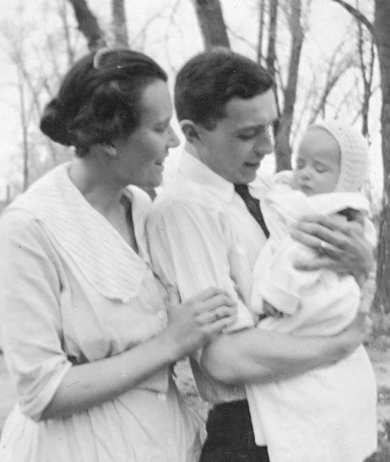 The 1920 census
takers found the young family--including
two-year-old Baxter--living at 299 Fourth Avenue
in "Arcadia City" of "Pasadena township." It was a
small wooden house that Walter built with his own
hands in an otherwise wide-open field.74a Due to the construction
of the 210 Freeway (the relevant section of which
was completed in the fall of 1968), the original
Wolf address no longer exists, much less the house
that Walter built. Currently the lowest numerical
addresses on Fourth Avenue are 306 and 311,
flanking either side of a dead end butting up
against the freeway wall. The 1920 census
identifies Walter as a carpenter. Voter records from
the same year confirm the address ("4th Ave") and the
occupations ("carpenter" and "housewife" respectively) of these
two democrats, Walter and Helen. The first Wolf Christmas in
California was overshadowed by the arrival of
twins the follwoing day:
Walter Richard Wolf, Jr.,
(12/26/1920--3/39/2007) and Clara Louise ("Helen")
Wolf (12/26/1920--12/29/2007). Apparently it was Walter, Sr. who lobbied to name his daughter after his mother, but his wife always considered her to be "Helen, Jr." The family was
still living in Arcadia three years later when, on
February 21, 1923, Robert
Eugene ("Bob") Wolf (2/21/1923--4/20/1996)
was born. In 1925, the family moved to nearby
Monrovia, where, according to Walter, Jr., they
had a goat that provided them with milk ... and
eventually a baby goat! Walter, Jr., recalls a
subsequent move to Highland Park, where they lived
in four different places, each for only a short period
of time. It was there that the Wolfs got their
first car: a 1922 Chevrolet touring car, which,
Walter, Jr., remembers, was used on occasion to
take the family to Hermosa Beach.
By 1930, the allure of the coast inspired
yet another move, this one to Redondo Beach, which
Helen Keyt Wolf had always remembered fondly as the place
where she and her Denver family had vacationed on her
fifteenth birthday. It was in this coastal enclave that the 1930 census takers found
the Walter Wolf family. Aside from his wife Helen (age 35), the
household included the four children, ranging in
age from Baxter (12) to "Bobby" (7), plus a
"lodger" named Helen J. Pruner (age 10) from
Michigan. In that census Walter is listed as a
38-year-old independent commercial artist, which
seems mostly to have involved painting cardboard displays for
department store windows in downtown Los Angeles.
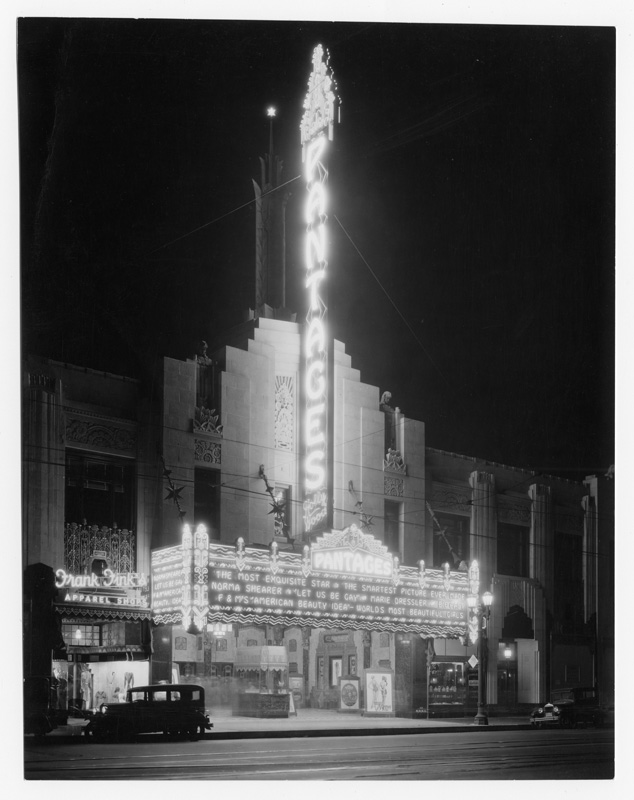 At one point Walter worked
for the
Metlox ceramics company in Manhattan Beach.
According to a local history website,
The "early success [of Metlox] came in the
manufacturing of large ceramic letters for neon
signs in an eye-catching style that was used for
the early movie palaces in the late 1920s and
early 1930s, most famously for the Pantages
Theatre in Hollywood, which opened in 1930."
Walter applied his freehand lettering skills to
help create patterns for the neon signs. This was
good work for him, but the Depression prompted
Metlox to terminate the neon sign part of their
business and focus on more conventional ceramics.
This would have been about the time that Walter purchased his second car (as reported by Walter, Jr.), a 1926 Studebaker "Big-Six"
touring car. In the South Bay area, the family
moved frequently from one rental to the next,
regular paychecks being hard to come by. According
to Walter, Jr., his uncle Tom teased his brother-in-law, Walter,
saying "it must be cheaper to move than to pay
rent." The summer of 1932 brought the Olympics to Los Angeles;
Walter Wolf remembers a visit to Olympic Village,
where he and his siblings met some of the
athletes. Less than a month after the closing
ceremony, the family welcomed little Carol Ann Wolf (9/7/32--), the
last of Walter and Helen's five children. Carol was born
in Hermosa Beach.
 At that time the family was attending a Christian
Science church, so Carol Ann was born with a
"practitioner" present. In the end, complications with the delivery led to the timely intervention of a conventional doctor.
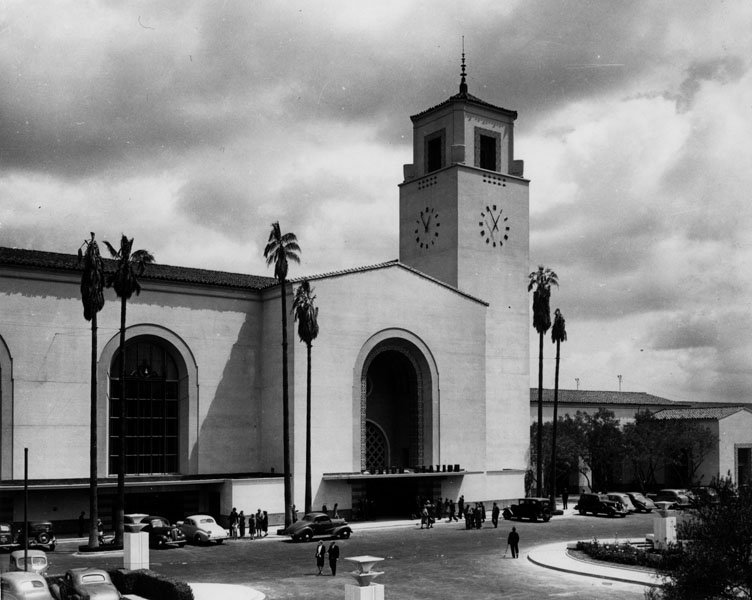 In July
1939 at age 18, Helen's oldest daughter Clara Louise (a.k.a, "Helen") would make the
pilgrimage to Lee's Summit, Missouri, the
headquarters of Unity Church, to attend a "Youth
of Unity" (YOU) conference. She set out by train from Los
Angeles' Union Station, which had opened for
business only two months before. Carol Ann--who
remembers the excitement of seeing her older
sister off at the station--also reports being
steeped in Religious Science and other
manifestations of the "New Thought" movement as she was growing up,
thanks to her mother. Many of the poems that Helen
wrote and left behind in her "button box" reflect
her unwavering faith in the power of positive
thinking.
 campaign. But it was "Walter Wolf's Wonder
Waffles"(a.k.a. "Walter Wolf's World-Wide Wonder
Waffles," a.k.a. "Walter's Wonderful World of
Waffles," and "Walter Wolf's Wonder Waffles") that
stands out as his most memorable entrepreneurial
venture.74b By building
this tiny brick diner himself (in the spring of
1931), he avoided much of the overhead normally
associated with a new business. And it survived the big Long Beach
earthquake of March 10, 1933. Walter, Jr.
recalls his father applying his sign-making skills in crafting a big metal waffle sign. There are unfortunately no images of that sign, but
the two pictures of the waffle shop that do
exist not only testify to its diminutive dimensions, but
provide a glimpse of the menu: "Waffles 15 cents, Toasted Sandwiches
10 cents, Soup 5 cents, Salad 5 cents, Chilli
[sic] & Beans 5 cents, Entrees... Sandwiches...
Desserts... Coffee...." The fact that the
restaurant was so small (offering its customers no
more than a counter to sit at) and the fact that
Walter had financed the building by selling meal
cards--cards that entitled the holder to a break
on the cost of a number of meals--meant that when he
finally opened for business, Walter suffered from
a real cash flow problem. He also found it
expedient to expand the menu, and so he enlisted
Helen to cook other dishes at home. This
"outsourcing" was made possible by Baxter delivering
the home-cooked food to the waffle
shop in the family Studebaker, even though
he was only thirteen at the time. As his
younger brother Walter would later recall, "On his
14th birthday, Baxter went to the City Hall to get
his license.
 Eddie
Messenger, the Chief of Police, surprised Baxter by saying there
was no need for a driving test. "I've seen you
driving past here many times." Even after
expanding the menu, Walter had trouble breaking
even, and his waffle business lasted only a year and a
half. In November 1933 the Wolf family left the
South Bay area altogether and relocated to
Glendale. According to Walter, Jr., the point was
to be closer to potential commercial art jobs. In
1934, Helen's widowed mother, Gertrude Grubbs Keyt
("Mima," to her grandchildren), appears in the
voting records as a resident of 117 S. Isabel
Street in Glendale. Depending on when she moved
there, this might explain the choice of Glendale
as a new home for the Wolf family.
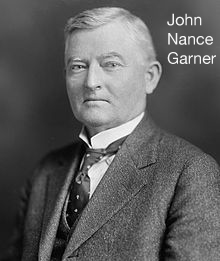
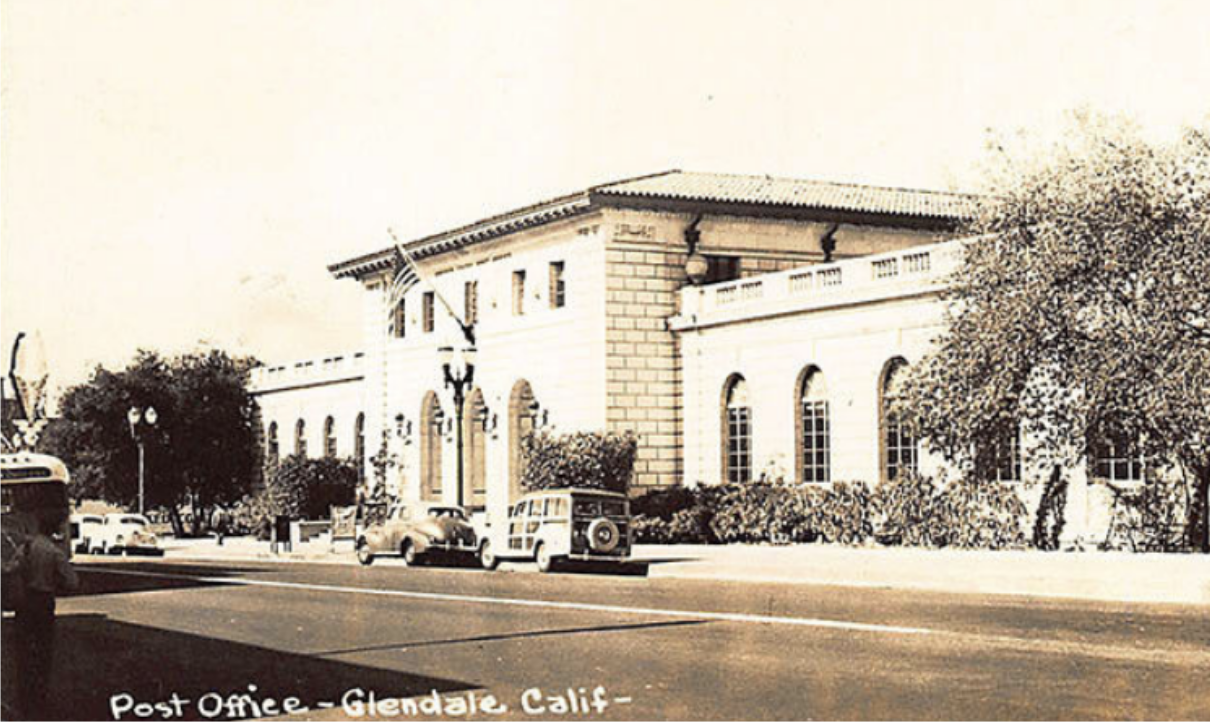 In any case, Walter Jr.
remembers being a part of the Boy Scout honor
guard for the dedication of the new Glendale post
office building (1933), where he got to shake the
hand of Vice President, John Nance Garner, a.k.a,
"Cactus Jack." Voter records from 1938 place
Walter, Sr. ("artist") and Helen ("housewife"), both
registered democrats, at 1262 Ruberta Avenue in
Glendale.
"A
Life-long Love Affair with Aviation"
"A Man and his Wheels"
"To My Sister, Carol
from Walt"
"Politics and I"
"The Boy Scout and the
Vice-President"
"St. Patrick's Day, 1944"
"War's
End/Hiroshima"
"Hiroshima"
"Homeward Bound. Osaka to
San Francisco, 1946"
"KEYT-TV, an Adventure in
Time"
"Memories of Helen
Clara Louise Wolf Shanteau"
 Great Depression only added to the family's
economic woes. Economic problems strained relations
between Walter and his older children. He insisted from
very early on that they earn their keep by taking
on odd-jobs to help support the family. More than once, when Walter
couldn't find work in Los Angeles, he left for Denver
and stayed with his older sister, Helen Ernst,
and her family. But there were no more job opportunities there than in Los Angeles very little money found its way home to his family. According
to Helen's son Gene Ernst, his family did not
condone Walter's periodic abandonment of his
family. Nevertheless they felt obliged to assist
him when he turned up on their doorstep, confident
that his mother-in-law Gertrude75 would help keep her
daughter's family afloat.76 But the real "angel" as
far as the Glendale Wolfs were concerned was "Cousin
Margaret" from Cincinnati.
 Margaret's parents were
John Jackson Burchenal and Leota Blanche
Grubbs (b. 9/14/1862 in Richmond,
Indiana). "Otie" must have been an informal version of "Leota."
She was was the youngest of four
children of John Warren Grubbs
(6/6/1820--3/17/1893) of Cynthiana, Kentucky and
Mary-Margaret Ramsey (5/8/1823--2/?/1881) of
Washington County, Pennsyvania. John Warren Grubbs
was the son of William Gardiner Grubbs
(11/27/1786--4/20/1850) of Fayette, Kentucky and
his second wife, Rebecca Croake (10/26/1796-1872)
of Virginia. They had nine children, the oldest of
which was John Warren Grubbs, Leota's father. The
fourth oldest was Thomas Marshall Grubbs
(9/12/1825--4/27/1864; born in Kentucky), the
father of Gertrude Gardner Grubbs
(5/29/1860--4/8/1945). Because John Warren Grubbs
and Thomas Marshall Grubbs were brothers, Leota
("Otie") Grubbs and Gertrude Grubbs were first
cousins, making Helen Cary Keyt and Margaret Kent
Burchenal
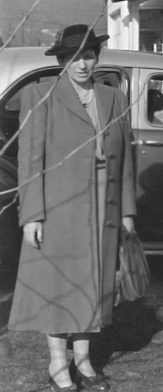 Rogan second cousins. Despite the genealogical and geographical
distance between Margaret Rogan of Glendale, Ohio
and Helen Keyt Wolf, of Glendale, California,
"Cousin Margaret" took it upon herself to help her
struggling west-coast kin. Being in the habit of
wintering in Pasadena at the famous Gamble House,
Margaret had regular contact with Helen and her
family. Margaret helped finance three different
home purchases in Glendale for Helen and her
family: one on Idlewood Road, another at 1262
Ruberta Street, and a third at 1064 Newby, where
Helen and family would stay for many years.76a According to Walter, Jr.,
an affluent friend of Margaret's was so impressed
by Baxter's efforts to keep the family afloat
that she bought him a used 1932
Chevrolet sedan to replace his tired 1926 Chevy.
But the Wolf children's fondest memories of Cousin
Margaret centered around Christmas, when she would
provide boxes of gifts for them. Once she even
arranged for a New Year's Day (1931) family
excursion from San Pedro to Catalina Island on
board the S.S. "Catalina." But Margaret's
generosity was not confined to the holiday season.
She also regularly provided young Helen with
formal dresses for her dances and Carol Ann with
dolls and ultimately voice lessons. Carol vividly
remembers the time in the late 1940s when Margaret
came to pick her up from high school in a
limousine, taking her to her singing lesson in
style. Margaret even offered to pay for Carol to
attend the Cincinnati Conservatory of Music, but
Carol declined, already engaged to be married at
the time (1951). In 1952, Carol went by train to
visit Margaret in Ohio. The last time that Carol
remembers seeing Margaret was in 1962, when she
and her four small children went to visit Margaret
at the Gamble House.
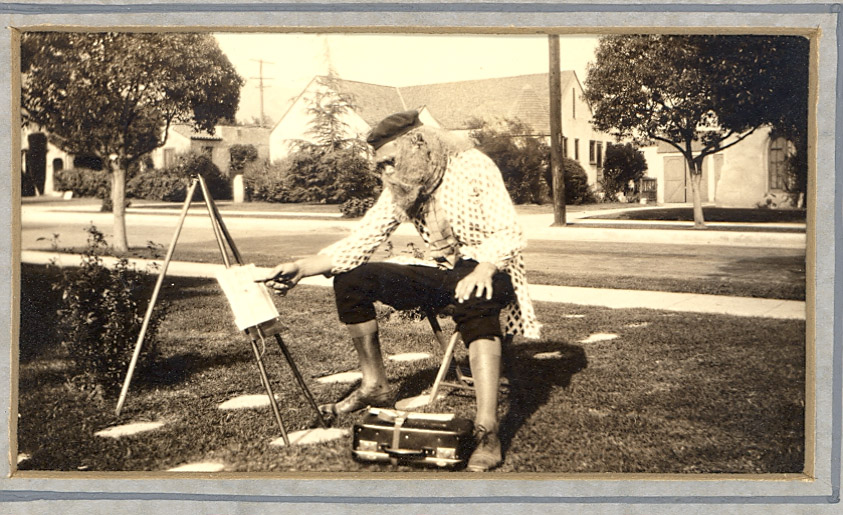 Baxter also put in time at the the
federally-sponsored WPA gardens not far from the
Wolf home on Newby so as to earn a share of the
produce. Before long he secured a night-shift job
at Gladding, McBean ceramics company,
putting his own high school art class experience
to work making terra cotta pots. In the midst of
this, Baxter and his brother Walter Jr.--who both
towered over their father--executed a sort of
 familial "coup d'état," by
insisting that he (who had returned from Colorado
after Helen had secured the house on Newby) share
more of the burden of supporting the family.
Walter, in turn, insisted that his older children
contribute 50 percent of their earnings to the
household budget. Angry at the insubordination of
his sons, Walter made Helen choose between him or
her children. When she (apparently with some reluctance, because her
relationship with her husband was always a
passionate one) chose the children, Walter left
the family for good, returning temporarily to
Denver where he worked in a feed store. That was in September, 1940. His
youngest child, Carol, remembers her mother
saying that out of her first eight years of
life (1932-40), her father was present for only
four of them. Carol remembers writing her father a
letter in late 1940 asking him to come home for
Christmas, which he thought best not to do. Walter did return to California,
but he seems
to have had little or no contact with his family.
Carol remembers that once in 1942, when she was
ten years old, he showed up completely
unannounced at her grammar school in order to see
her. Fast-forwarding to about 1950, Carol
remembers her boyfriend, Bob Baldwin, asking to
meet her father, a request that upset her mother
even though that visit never materialized.
At some point, presumably after he returned to
California, Walter met a woman named Hazel
May Miller (10/8/1908-8/6/1984), whom Walter for some reason called "Susan." In order to marry
her, Walter had to file for divorce from Helen.
Helen challenged this, counter-filing on the
grounds of desertion and she won, though she never
succeeded in collecting any alimony or child
support.
 According to family lore, Walter and
Hazel once ran into Tom Keyt, his former
brother-in-law, who had not yet been informed of
the divorce. An awkward moment, no doubt. In any case, Walter and Hazel married
on September 11, 1944. According to voter records
from that year, the couple--identified
professionally as an "artist" and a
"housewife"--began their new life together at 557
N. Berendo Street in East Hollywood. Walter was 52
at the time of his second marriage and Hazel, 35.
They seem never to have had children of their own.
The only one of Walter's children with whom he
maintained contact was his youngest son Bob. The two seem to have enjoyed a special bond. Reminiscing about his father,
Bob remembered him as an avid USC football fan,
who loved to listen to the games on the radio
while munching popcorn. Bob fondly recalled accompanying his
father to see USC play in the Rose Bowl.
 Not surprisingly, Bob's success as a
"light-weight, signal-calling fullback" for Hoover
High was a source of immense pride for his father.
For his part, Bob remembered being impressed with his father's
command of the English language, despite his lack
of formal education, as well as his uncanny ability to
fix and build things. "There was nothing that dad
couldn't do and do well. He was a perfectionist."
But in the end even Bob's connections with his
father wore thin when Walter took offense at a
donation that Bob made in his name to the Heart
Association, for which Bob worked at the time;
Walter made it clear that he preferred the kind of gift that came
wrapped in a box. Walter managed to maintain
better ties with his family in Denver. Gene Ernst,
Walter's nephew, kept in touch with his uncle, and
remembered Walter and "Susan" (Hazel) as a
reasonably happy couple despite their perpetual
financial problems. After Gene's last trip to
California in 1957, Christmas cards and cookies
were the only link between uncle and nephew.
Walter clearly played a much more active role in
his second wife's family. Teresa Miller Swafford
(a granddaughter of Hazel's brother) came across
this website and informed me that Walter was her
dad's (David Miller's) favorite uncle and that he
"was a real character."
 During the visit, Margaret received a
call from the president of The Masters School, a
private girl's boarding school in Dobb's Ferry,
New York. A medical emergency had left him in need
of a resident house mother and he sought
Margaret's recommendation for a suitable
substitute. It just so happened that the perfect
person for the job was sitting right there in her
living room, and so Helen was off to New York to
begin a new chapter in her life. In 1952 Helen's
daughter Carol took the train to visit Margaret in
Cincinnati and then continued on to visit her
mother in Dobb's Ferry, staying with her there for
a few days. She remembers how happy her mother was
at the Masters School. Unfortunately Helen was
diagnosed with colon cancer in 1956 and underwent
a colostomy. Thank goodness (recalls Carol) that
the school provided medical insurance. Undaunted,
Helen continued working as the housemother of
"Second House" through the 1958-59 school year, by
which time she had reached the mandatory
retirement age of 65. A scrapbook given to her
by the last students to benefit from her guidance
contains an assortment of pictures, cards, and
letters of recommendation. Helen's reputation at
Dobbs Ferry helped her secure a similar position
at the The Bishop School in La Jolla, California.
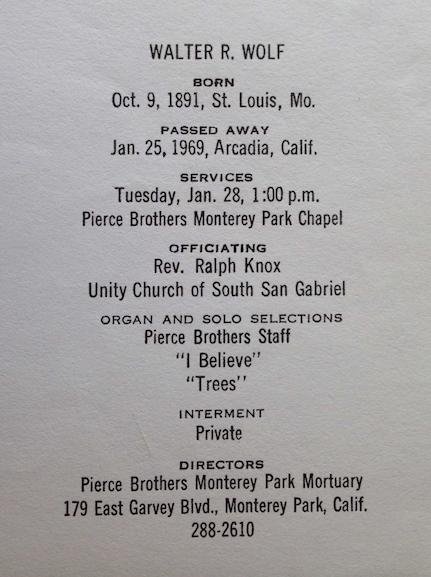 When her cancer returned, Helen, now fully retired, went to live with
her son Bob and his family in Ventura, in a room
decorated in purple, her favorite color. She died
there at the age of 69 on July 25, 1963.78
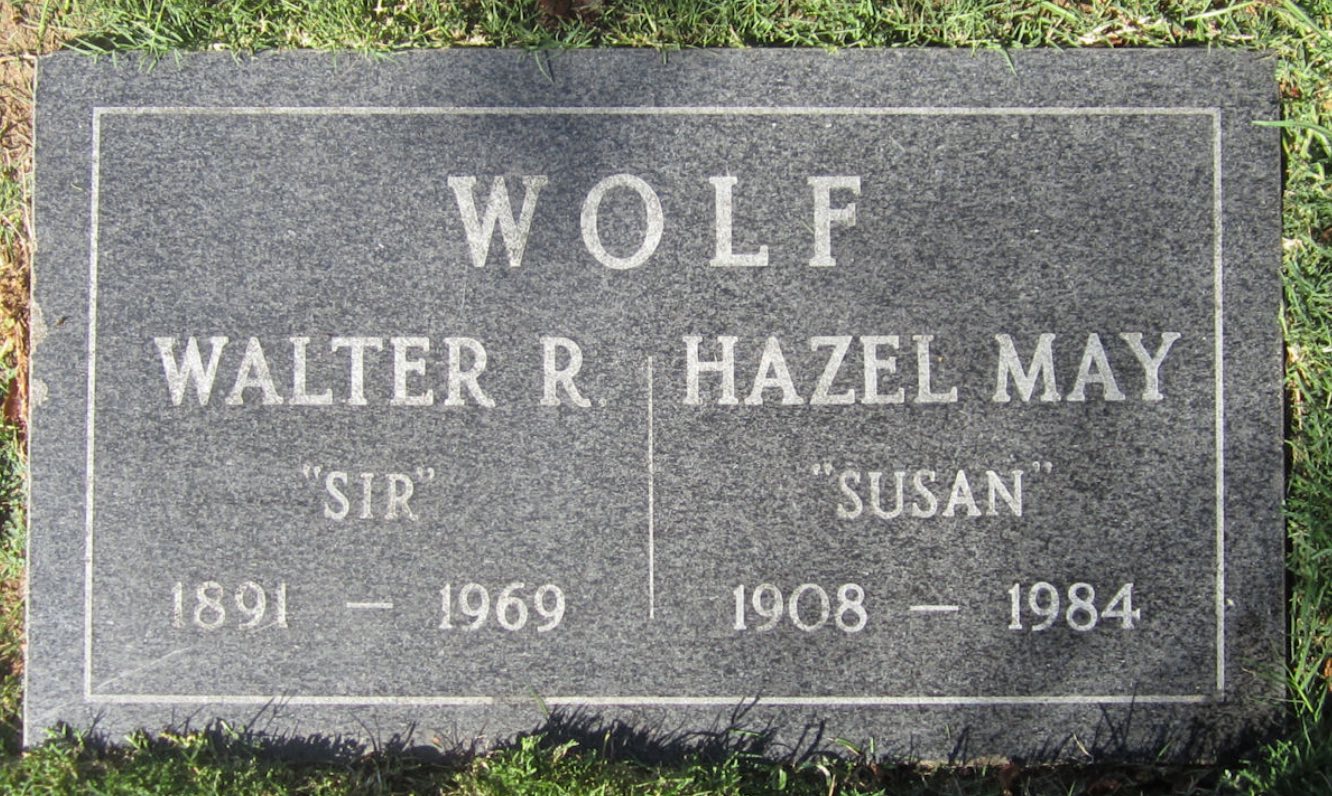 Five and a half years later (on January
25, 1969), Helen's ex-husband Walter died in a
convalescent hospital in Arcadia, where he had
suffered from the final stages of lung cancer.
His memorial service was held at Unity Church of San
Gabriel and he was buried in Inglewood Cemetery. The section in which he is buried affords an impressive and unobstructed view of Sofi Stadium to the south.
Walter was survived by his widow, Hazel ("Susan") and his five estranged
children from his previous marriage. They seem never to have been informed of their father's
demise. His death certificate lists his last place
of residence as 9522 Giovane St. in South El Monte,
and his occupation as a vacuum cleaner salesman.
He had worked for the Electrolux Company for at least seventeen years.
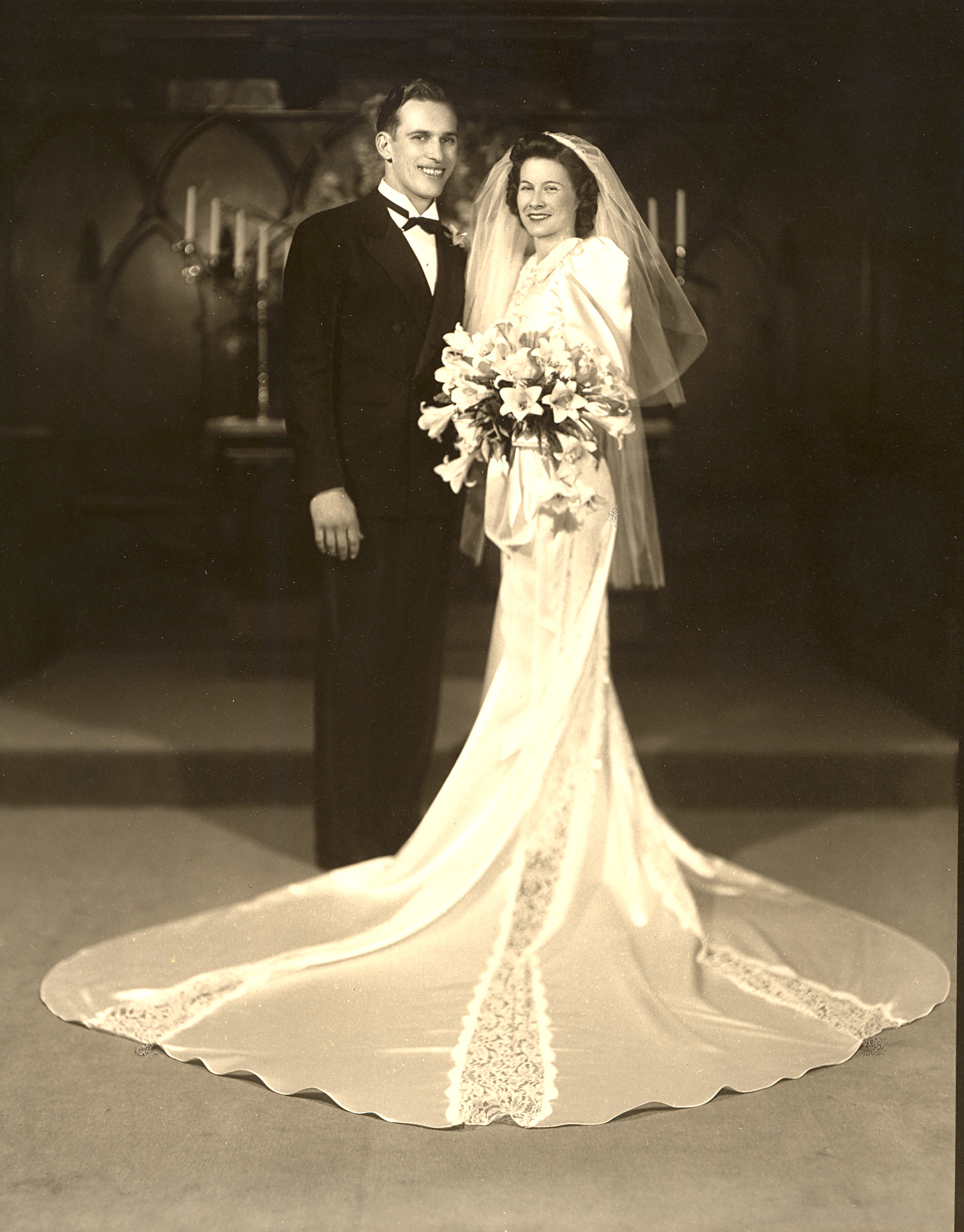 left for their honeymoon on Catalina Island, and
then set up their new home in one of the units of
a court on Justin Avenue in Glendale, not far from
the Wolf family home on Newby Street. Later they
moved to a house on Stocker Street, where they
were living when Linda Jean Wolf was born
on July 27, 1942. At that time the United States
was in the process of mobilizing for war in Europe and the Pacific.
Due to Ruth's pregnancy, Baxter was eligible for a
draft deferment that led to his employment at Lockheed Corporation in
Burbank, where he contributed to the war effort
and learned draftsmanship in the process.
While Linda was still a toddler, Baxter and
Ruth bought their first home in Roscoe (now called
Sun Valley) in the San Fernando Valley, but soon
decided that that part of greater Los Angeles was
not for them. So Baxter bought an empty lot in
Altadena, (at 150 W. Foothill Boulevard, now
Altadena drive), secured temporary quarters for
his family at his mother's house at 1064 Newby,
Street, and, in his "spare time" (while working
long hours at Lockheed), began building a home.
 Baxter's plan was to build the garage first
and then use it, in modified form, as a home while
he finished the house proper. In the end, that
provisional garage-home was deemed sufficient,
with one subsequent addition, and no separate
house was ever built. Baxter and Ruth's first son,
William ("Bill") Baxter Wolf--born three
days after the Japanese surrendered on August 18,
1945--was six months old when the family moved
into their new garage home. Baxter, Ruth, Linda,
and Billy, lived there from the beginning of 1946
until August 1954, when they moved to Santa Barbara. Unfortunately the house that Baxter built in Altadena, like so many others in that area, burned to the ground as a result of the Eaton fire in January, 2025.
The decision to move to Santa Barbara was an easy one for Baxter and Ruth. Baxter's favorite uncle, Tom Keyt, had lived Santa
Barbara on and off from shortly after his marriage
(September 6, 1922) until his death (November 20,
1958), making the town a natural focus of visits
for Baxter and family. Baxter's love of the sea,
stemming from the time he spent growing up in the South Bay, and the rising smog levels in
Altadena ultimately led him to follow Tom's
example and relocate to Santa Barbara.
 The family first rented a house at 408 Grove Lane,
in the middle of the lemon orchards just south of
Foothill Road. There, on September 17, 1954--just
a month after the move--Ruth gave birth to
Richard ("Rick") Baxter Wolf. Less than
three years later, on June 1, 1957, came
Kenneth ("Ken") Baxter Wolf, the last of
Baxter's and Ruth's children. In the spring of 1961, after
seven years on Grove Lane, Baxter and family moved
to a brand-new house in the Mesa area of Santa
Barbara that he purchased for $16,000. A year later, Baxter decided to take a
job in Campbell, California (near San Jose), but
it was only a matter of months before he and Ruth
decided to move back. Fortunately the house they had left behind at 333 Linda Rd. was still on the market, so they were able to move right back in.
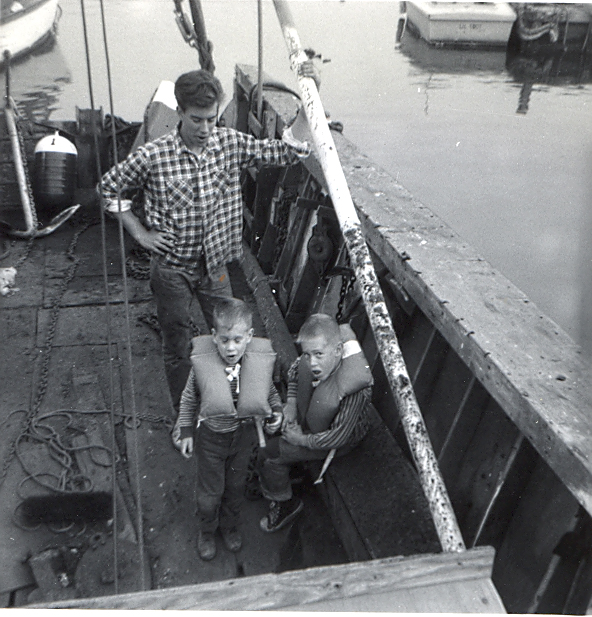 Like his father, he was a natural
artist, he could craft anything with his hands, and
he innately understood how all things mechanical
worked. When he married Ruth in 1941, he was
working for Vega, a subsidiary of Lockheed in
Burbank. Then he worked for Lockheed itself. After
the move to Santa Barbara, he worked, among other
places, at Smith-Nelson, a machine shop, and Astro
Research, a company that supplied parts for the
nascent space program. But he was always drawn to
the sea. For a time he had a barge in Santa
Barbara harbor and made a living securing and
maintaining permanent moorings.
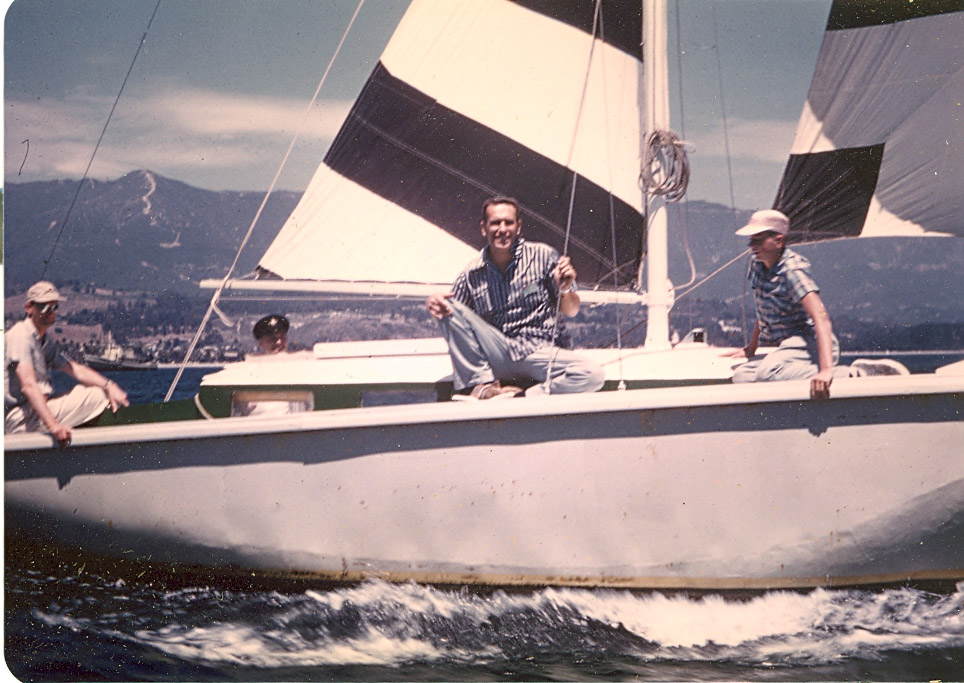 His son Bill remembers long
hours as a young teen working on the barge. Later
Baxter decided to apply his Lockheed-honed talents
as a draftsman to boat design. After serving an
apprenticeship with John Leuschen, a local naval
architect with an office at the harbor, Baxter
ultimately bought the business and entered into
the most fulfilling phase of his work career, as a
naval architect, marine surveyor, and compass adjuster. His sons
Rick and Ken remember spending lots of time down
at the harbor, sometimes helping in the office,
but mostly fishing in the harbor with drop lines purchased at
Carter's Bait and Tackle or renting rowboats from
Otto Fisk. One of the other fringe benefits of
Baxter's new career was the fresh fish that grateful
clients would send his way.
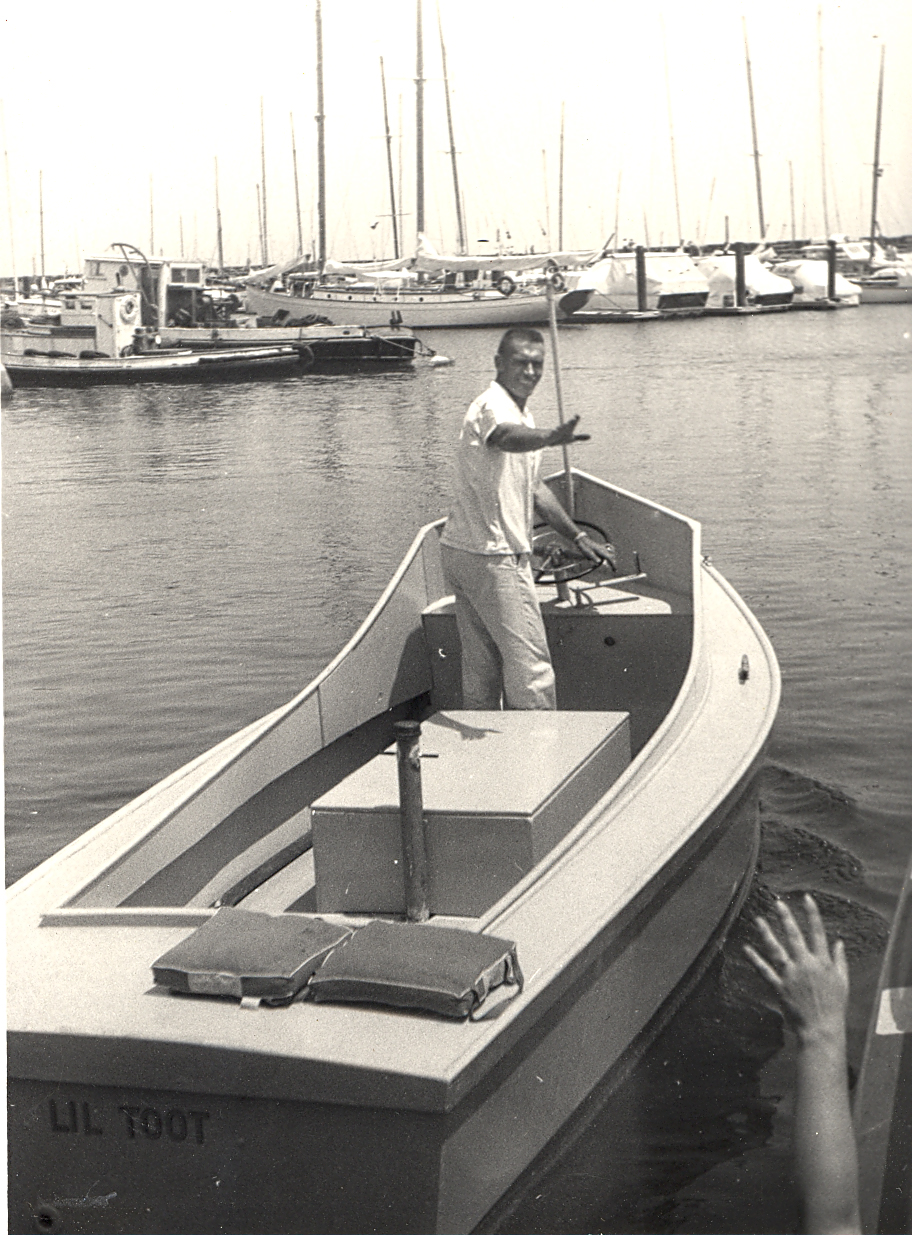 A master
of the backyard barbeque, Baxter's swordfish came
to be as legendary as his chicken. Baxter worked
at the harbor for a number of years, witnessing
first hand the famous oil spill of 1969. But
ultimately he could not make a consistent living
so he accepted a position as an engineer at Rolair
Corporation in nearby Goleta. As disappointing as
it was to leave the harbor behind, his family
thrived on the regular paychecks.
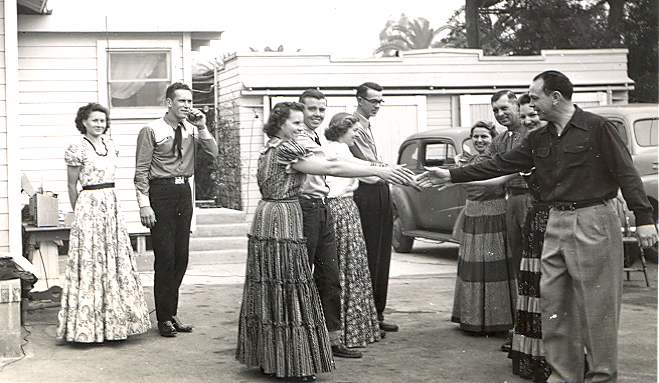 Baxter also loved
boating. The garage on Newby in Glendale witnessed
his first boat-building effort. After the move to
Santa Barbara, he built or refurbished other small
boats, including "Los Lobos" and "Lil Toot." He also
borrowed bigger ones, leading to the occasional family
expedition to the Channel Islands off the coast
of Santa Barbara, and Catalina off of Los Angeles. Baxter became a member in the United
States Power Squadron, an organization dedicated
to the promotion of safe boating, and rose to the
position of District Commander. When he no longer
worked at the harbor, Baxter followed his two
youngest sons into scouting, becoming the
scoutmaster of Troop 52. Under his leadership,
with Jim Davis as his principal assistant, Troop
52 rose to be the flagship troop of Mission
Council, with weekend backpack trips into the
mountains behind Santa Barbara and Ojai every
month, an annual week-long stint at Rancho Alegre Summer Camp, and a 50-mile trek in the Sierras every
summer.
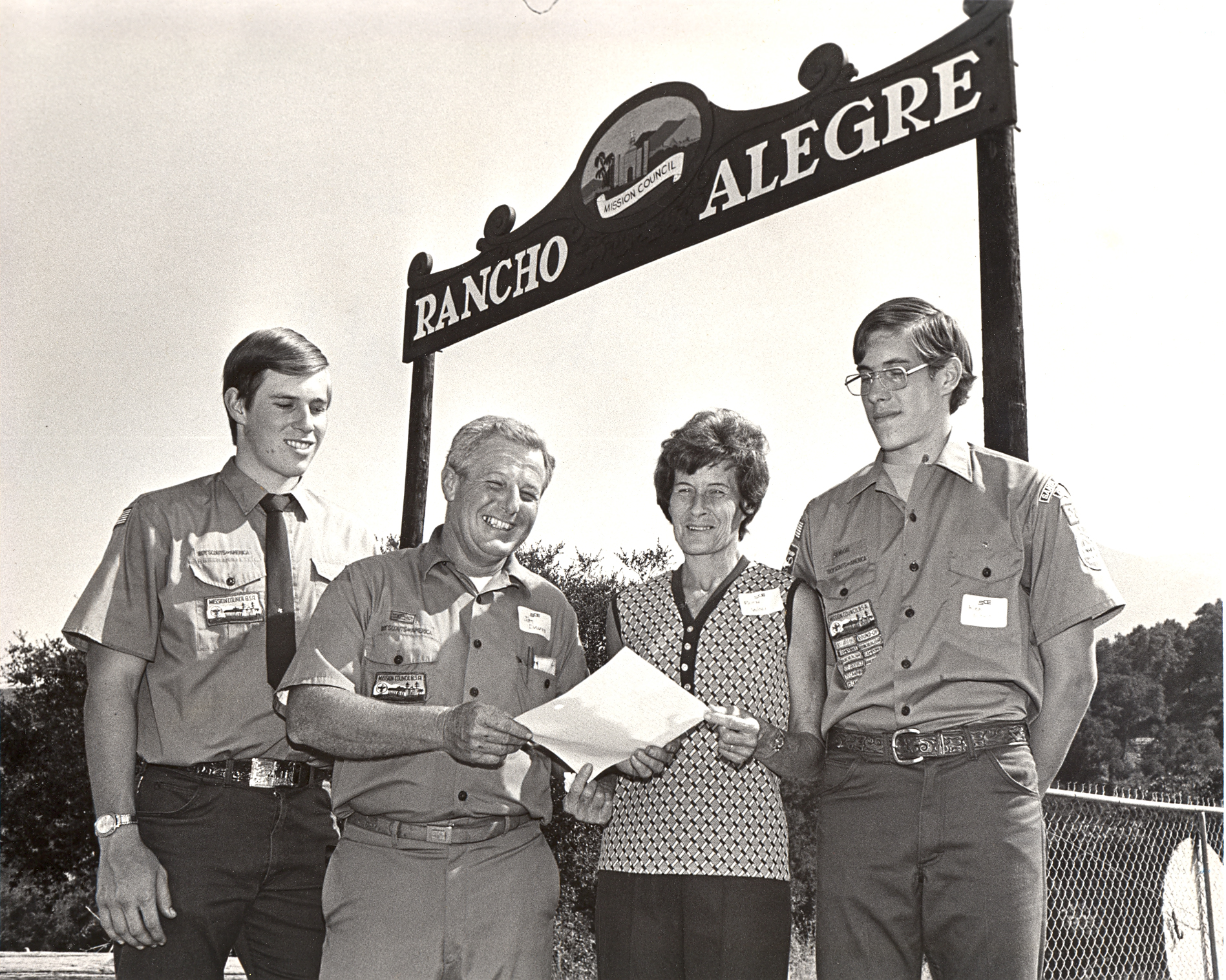 night before the saddest Father's Day in history.
To her great credit, Ruth, age 53 at the time,
quickly moved beyond this tragedy, thankful that
she still had children at home (age 16 and 18) to care for. She
found work as a baker in the local school
cafeteria system, where she had worked previously as a substitute.
Every school morning for the
next 22 years, she reported to work, mostly at La
Cumbre Junior High and Santa Barbara High, at the
crack of dawn. At age 75 she finally retired, not
so much because she was tired of the work but
because the services of a true baker were no longer needed in the new microwave age. She continued to make the house at 333 Linda Road a home for another 22
years until her death at age 97 on April 13,
2016. She died in her own bedroom at 333 Linda Rd., where she had lived for 55 years.
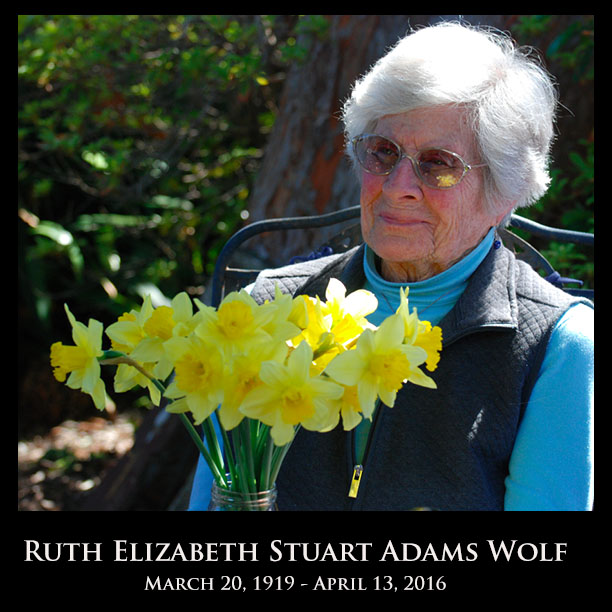

Postscript: New Connections
As a result of Walter Wolf's isolation, few of his many grandchildren ever knew him as anything more than a name. Aside from the children of his son Bob, only those of his daughter Helen ever met him, and even that was purely by accident. Walter just happened to stop by Bob's house in Santa Barbara when Helen and her family were visiting. Young Helen's oldest son Jim Shanteau recalled: "When I was young, I remember going to Uncle Bob's and Aunt Jo's for a reunion. There was a great deal of excitement among the adults because Walter Wolf, Sr. was there (by accident) visiting Bob. It was the only time I ever saw him and it was only briefly as he was leaving. As I recall some in the family wanted him to stay. But others wanted nothing to do with him." Walter's separation from the family also contributed to the relative lack of contact between the Colorado and California branches of the Wolf family. Gene Ernst recalled a trip that he made in 1930 to visit his cousins in Hermosa Beach. In July, 1939, Helen (Clara Louise) Wolf, who was eighteen at the time, visited her Denver kin by train, using the city as a link between Lee Summit, Missouri, where she attended the "Youth of Unity" conference, and San Francisco, which was hosting the 1939 World's Fair. While in Denver, Helen stayed with Alex Ernst (her uncle Louis Ernst's older brother) and his wife Betty, and got to know her cousins Howard and Gene Ernst and their families. In 1959 Helen Keyt Wolf visited Alex80 and Betty and attended the wedding of Gene Ernst's daughter Gretchen. Sometime in the late 1970s, Helen (Clara Louise) Wolf Shanteau called Gene's brother Howard from the airport in Denver. At about the same time, Alex and Betty Ernst's daughter Ruth (who lived in Tucson) contacted Helen and came to visit her and her husband Bob in Sun Lakes, Arizona a number of times.
This intermittent contact kept the memory of the Helen Wolf Ernst branch of the Wolf family alive; but barely. In 1989, W. John Wolf 81 (a great grandson of Wilhelm/William Wolf, Gustav's brother) of New Jersey reached across the continent to make contact with what he had correctly deduced to be descendents of Gustav Wolf. Ultimately his research, and the xeroxes of key documents and photos in the possession by John's mother, found their way to Ken Wolf (a great-great-grandson of Gustav) and a professional historian. He used them to inform his own efforts to locate the Wolf family in Germany. The two websites capturing all of this information, one covering the Wolfs in Germany and the other their descendents in America, have led to the rediscovery of two other long-lost Wolf family connections. Gregory Myers of Missouri provided key information about Eberhard Gustav Wolf, his great-great-great-great grandfather. And Tana Salvaggio of Wisconsin added virtually everything that is recorded here about the Baumgarth family in America.
Part One: The Wolf Family in Germany: 1740-1853
For more information about this branch of the Wolf family, contact: Ken Wolf (Gustav's great-great grandson): kwolf@pomona.edu

Path of
discovery: a presentation to the Santa Barbara
County Genealogical Society.
Special thanks to:
- W. John Wolf, for his work on the descendants of Gustav, William, Mina, and Amalia Wolf.
- Greg Myers, for his work on the descendants of Eberhard Wolf.
- Walter Wolf, Jr., Helen Wolf Shanteau, Carol Wolf Marshall, L. Eugene Ernst, and the late Bob Wolf, for their memories of Walter Wolf, Sr., and his family.
- Karen Shanteau Davis, daughter of Jim Shanteau and granddaughter of Helen Wolf Shanteau, who, gathered information on Gertrude Grubbs and Helen Keyt.
- Tana Salvaggio, for her work on the Baumgarth line.
- My wife, Friederike Liese-Lotte von Franqué Wolf, for her indispensable assistance with the German sources.
- All of the local archivists in Germany who dutifully answered my many letters, particularly Frau Pankrath in Plochingen.
- The former German Genealogical Society of America, whose library was added to that of the Southern California Genealogical Society in Burbank, CA.
- Ancestry.com