The Bremermann,
Briegleb, and Bartenstein Families
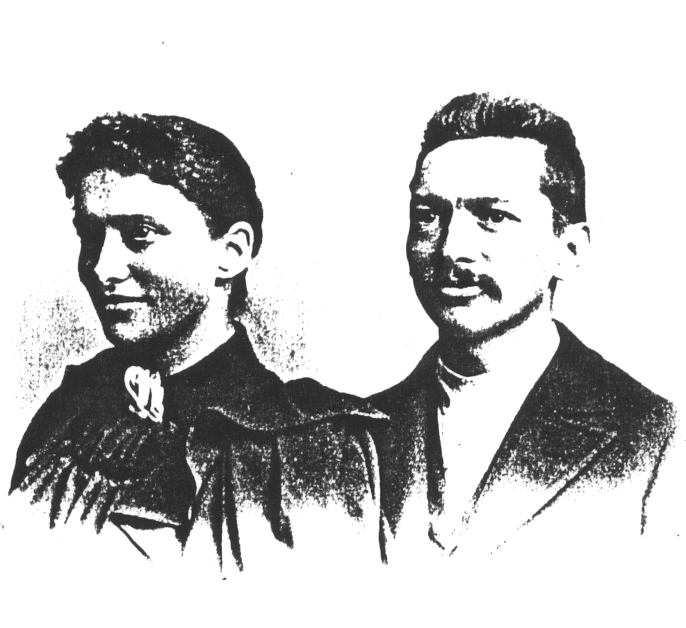
Eugene Wolf and his
wife Clara Briegleb Bremermann
Clara Johanna Briegleb Bremermann
(8/23/1863--10/18/1916), wife of Eugene
Wolf (8/23/1859--7/30/1901), was the product of a convergence of two German
families: the Bremermanns, from the northern German city of Bremen, and the Brieglebs, from the northern Bavarian town of Coburg. While we know very little about the Bremermanns when they were still in Germany, we know a lot about the Brieglebs.
It was in late 1837 that Clara's father, Gerd Bremermann (1814-10/1/1867) boarded the "Elise" in Bremen for America.
 Under the guidance of Captain John Koch, the ship arrived in New Orleans on December 22, 1837. The ship's passenger log
identifies "G. Bremermann" as a "22" [sic]-year-old "merchant" from Bremen. He is listed as one of the nineteen
passengers lodging in the "cabin" section of the ship, as opposed to one of the 172 in "steerage," suggesting that Gerd and/or his Bremen-based family had more resources than the average German immigrant at the time. The log also makes it clear that Gerd's final destination was not New Orleans but St. Louis, which meant he still had to endure a second leg of his trip via riverboat up the Mississippi.
Marriage
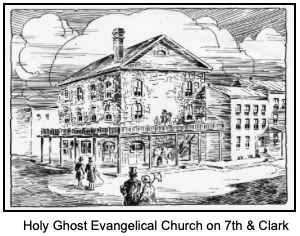
records in St. Louis indicate that Gerd Bremermann married Johanna Clara Briegleb (5/23/1822--7/20/1873) on March 22, 1844 in the "Evangelic Protestant church of St. Louis," officially known as the German Evangelical Church of the Holy Ghost (Deutsche Evangelische Heilige Geist Kirche). Founded in 1834, it was the first independent Protestant church in St. Louis (as distinguished from the German Lutheran church), with its first dedicated building constructed in 1840 at the corner of 7th Street and Clark Avenue (which, by the way, is now on the northern perimeter of the Busch Stadium complex). Its pastor at the time of Gerd's and Johanna's marriage was Frederick Picker (1843-1855), and indeed his name is listed on the Bremermann-Briegleb marriage entry. On October 21, 1844, seven months after the wedding, Gerd became an American citizen.
Clara's mother, born Johanna Clara Briegleb, was also a German immigrant, a native of the Bavarian town of Coburg. Born on May 23,
1822, she was the eighth of ten children of
Johann August Briegleb (12/12/1778-12/30/1847) of Coburg, and
Johanna Wilhelmine Heine (5/20/1786--2/12/1829) of the village of
Effelder in the Eichsfeld region of Thuringia. These ten children were: Emma Briegleb (10/1/1808-1/24/1866),
Ida Briegleb (1/30/1810-4/20/1859), Johann Ludwig
Friedrich Laurentius "Fritz" Briegleb (1/26/1812-10/18/1865), Christiane
"Cristel" Briegleb (4/4/1814-1/9/1878), Ferdinand
Julius Briegleb (12/11/1815-6/4/1838), Anna Johanna
Briebgleb (6/22/1818-7/8/1855), Friederike Briegleb (8/9/1820-1/24/1870), Johanna Clara Briegleb (5/23/1822-7/20/1873), Auguste Briegleb (12/12/1823-11/12/1875), and Caroline Briegleb (5/15/1825-6/1/1827).
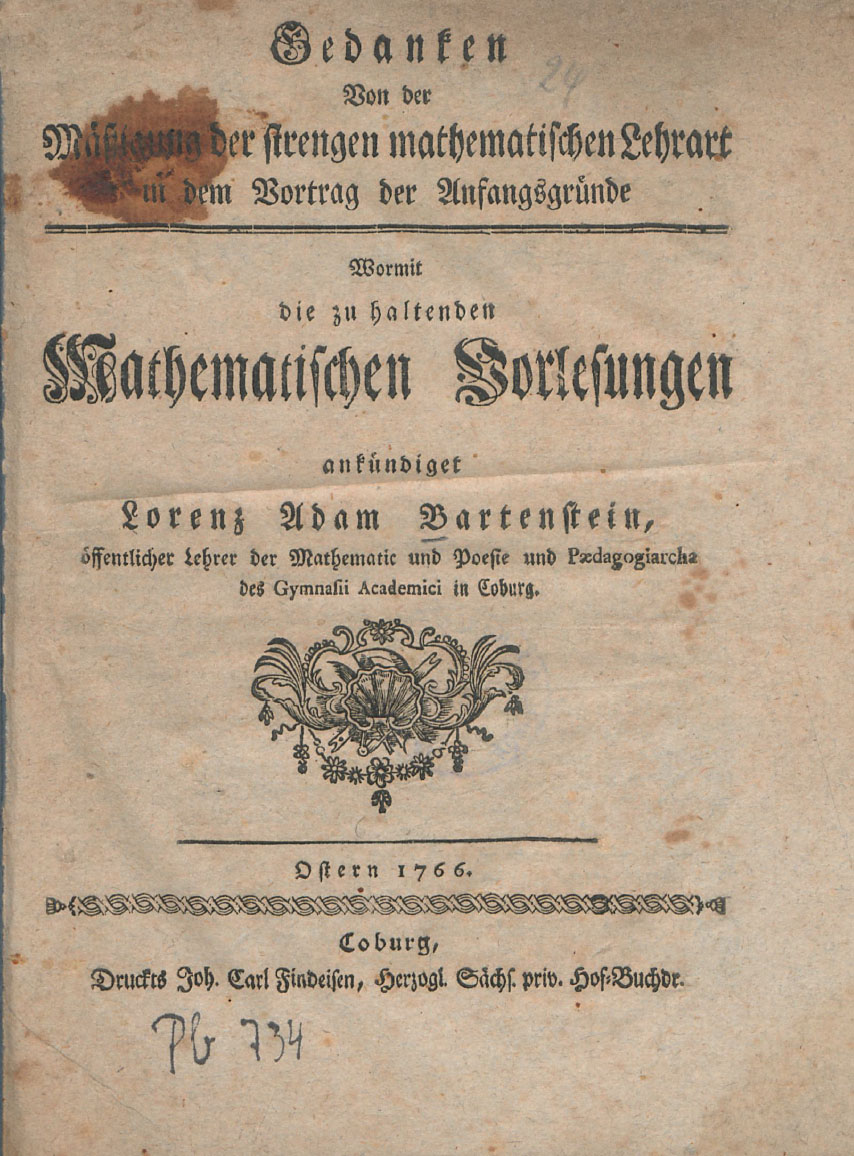
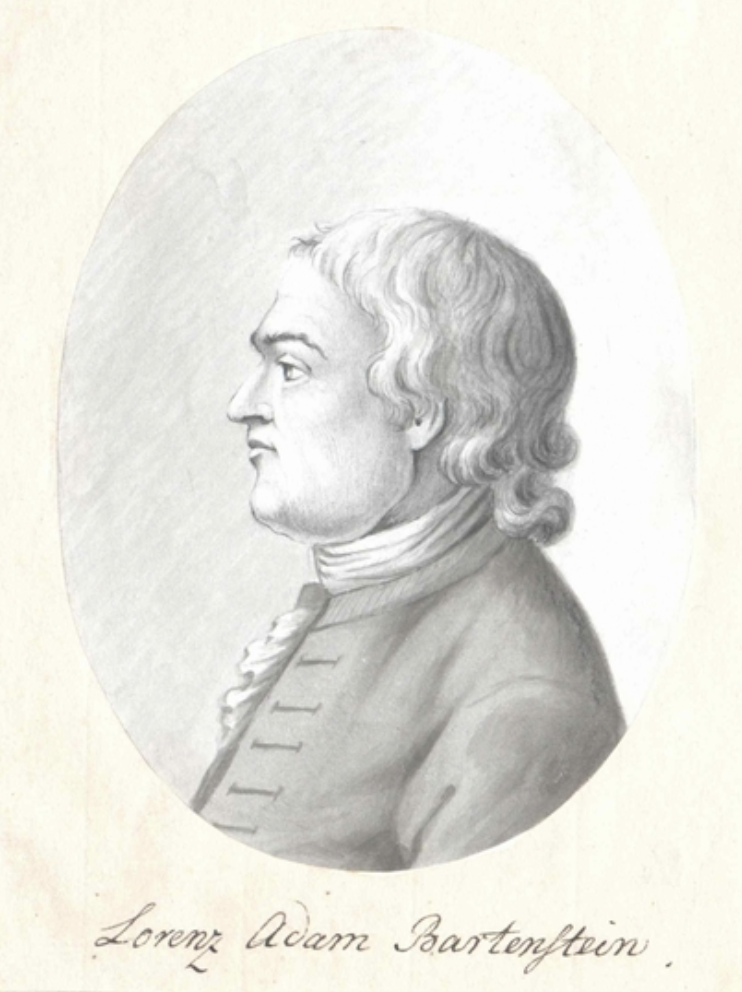
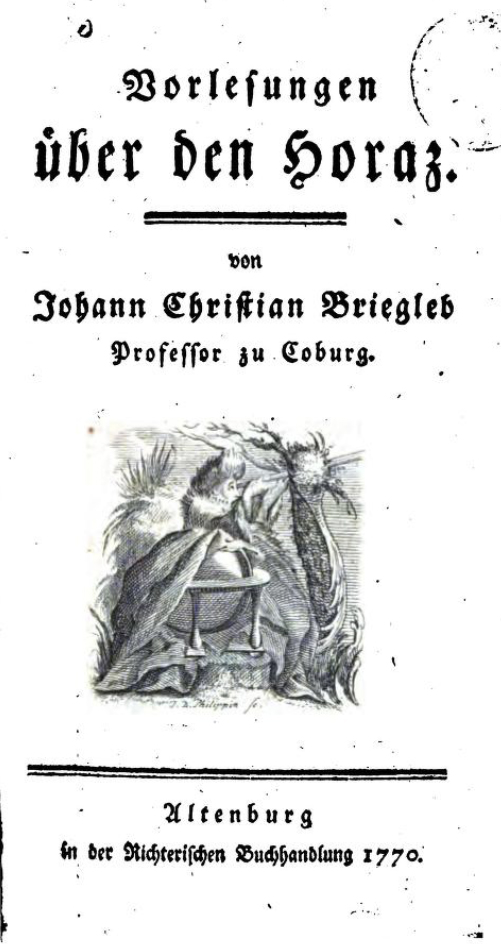
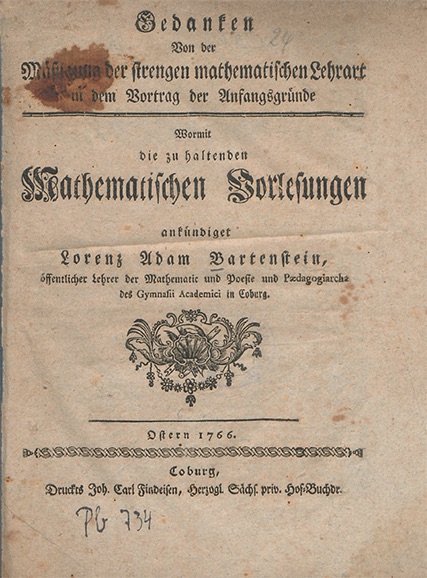
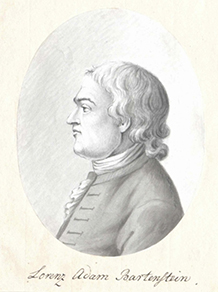
Johann August Briegleb came from a line of academics associated with the Casimirianum Gymnasium in Coburg, which was founded in 1605 by Johann Casimir (1564-1633), the Duke of Saxe-Coburg. Johann August Briegleb's father, Johann Christian Briegleb (12/2//1741--6/23/1805) originally of Gorlitz, and his grandfather, Johann Valentin Briegleb (1/3/1715--5/24/1782) of Gotha, were noteworthy philologists. Johann Christian's publication record, the weightier of the two, including a 323-page tome on Horace titled Vorlesungen über den Horaz (1770). It should also be noted in this regard that Johann August's mother (that is, the wife of Johann Christian Briegleb), Josephe Cristian Sabine Bartenstein (12/21/1745--9/20/1802), was the daughter of Lorenz Adam Bartenstein (9/28/1711--2/25/1796), a prominent Lutheran pastor and educator belonging to the same Coburg circle, as was his father, Adam Bertenstein (10/5/1675--7/18/1726). When Lorenz graduated from the "Casi," as it was affectionately known by its students, he went on to study theology, mathematics, logic, physics, and natural law at the University of Jena. After serving as a court tutor for a number of local counts, Lorenz made his way to Coburg and in 1743 was named Direktor of the Casimirianum, thereby following in the footsteps of his father. According to the Wikipedia article dedicated to
him, Lorenz Adam Bartenstein was a very active
scholar: "In addition to newspaper articles on
mathematical problems in the Coburg Intelligence
Journal, he published educational writings and
numerous programs for teaching mathematics,
religion, Latin and a simplified instruction on
the Greek language. From 1743 to 1751 he
published 180 occasional poems for both happy and
sad occasions." Lorenz' son-in-law Johann Christian
Briegleb would eventually also serve as the Casimirianum's Direktor, as would his grandson Johann August Briegleb. Prior to assuming that position, Johann August had studied both theology and philosophy at Göttingen University, in Lower Saxony, where he won a gold medal for an essay he wrote in 1799.** In
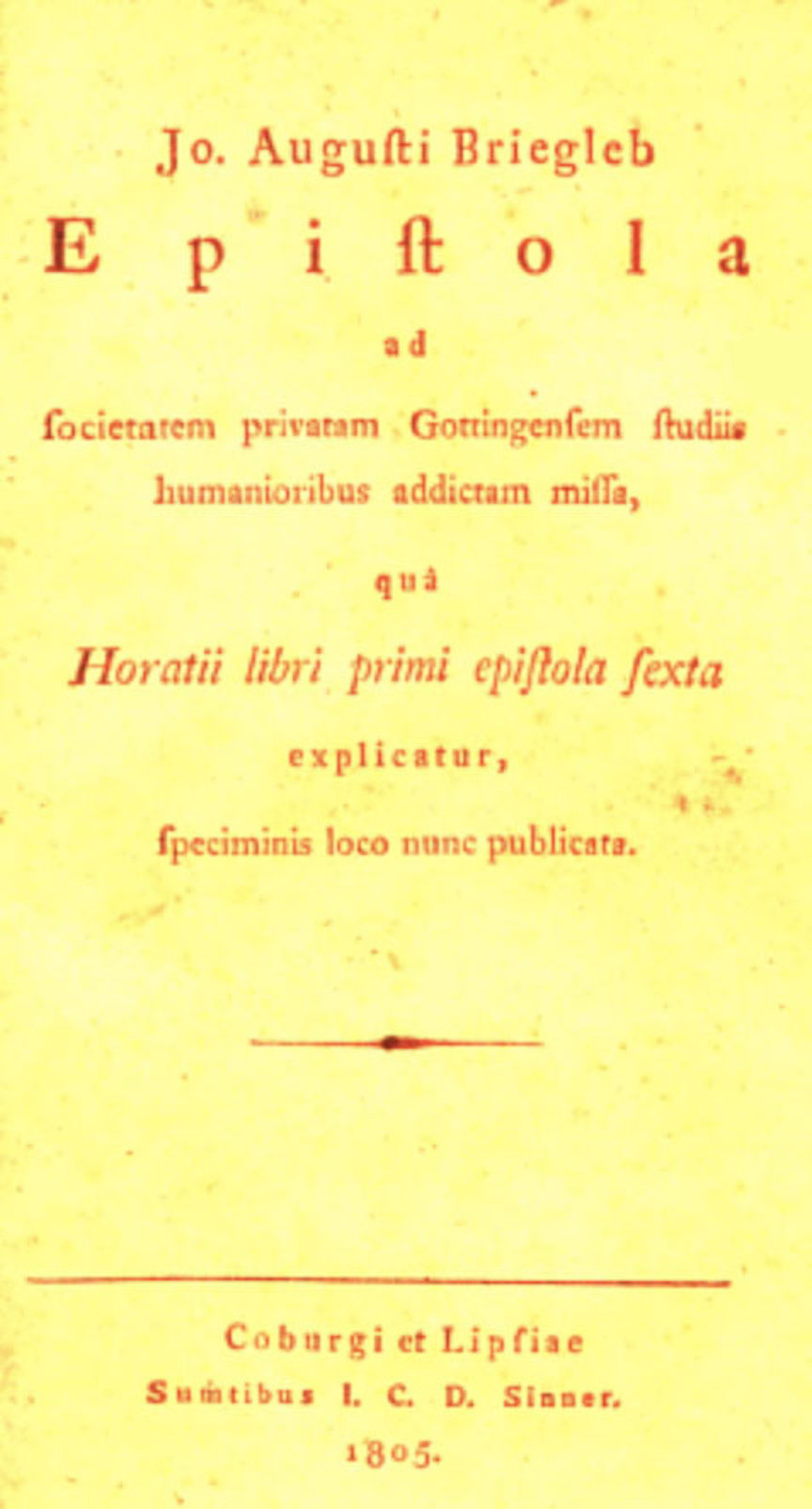
1805, he published an epistola (in Latin!) explicating one of letters of the Roman poet, Horace. He ultimately served in pastoral roles in the towns of Untersiemau and Weißenbrunn vor'm Wald (in the area of Coburg). His name appears in the Adress-Handbuch des Herzogsthums Sachsen Coburg und Gotha für das Jahr 1839 as pfarrer (pastor) of Weißenbrunn vor'm Wald. Johann August was better known outside of academic circles as the author of illustrated children's books. He published under the pseudonym Ernst Gottschalk, which translates as "earnest servant of God." Among these are Lauter Wahre Geschicten für Kinder (1820), Lauter unschuldige Mährlein für lieben Kinder (Nürnberg, 1835), and Possen und Schwanke, Schnurren und Schnaken zur Erholung für fleizige Kinder (1836)



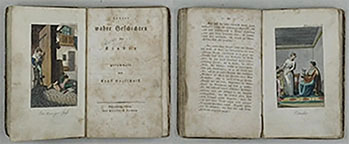
It should be noted that despite Johanna Clara Briegleb's formidable academic lineage and connections, she could never have been a student at the Casimirianum by virtue of her gender.
Johanna Clara Briegleb's path to Missouri was paved for her in part by the emigration of her older brothers, Ferdinand and Friedrich. According to the 1919 notes of Dr. Charles Briegleb, Ferdinand Brieglebcrossed the Atlantic in 1834, though there is no indication as to the specific reasons for this move. His older brother Johann Ludwig
Friedrich Laurentius "Fritz" Briegleb (1/27/1812--10/18/1865) arrived two years later (July 1836) under more dramatic circumstances. He had Followied in his
father's footsteps, studied theology at
the University of Jena, only to find himself
imprisoned in 1835 for "political
agitation." To help fill the time during his confinement, he produced
a remarkable book, Die
Coburger Liederhandschrift (The Coburg
Song Manuscript), that would later become an
important source for the study of early
nineteenth-century music in this part of
Germany. As the book's modern editor, Otto Holzapfel, has observed, Briegleb's volume was
"one of the first attempts to associate repertory
with region, and it therefore occupies a very
significant position in the intellectual history
of German folk-song scholarship." One of the
conditions of Friedrich's release from prison was
that he abandon his homeland once and for all and emigrate to America. He ended up on a farm in Saint
Clair, Franklin County, Missouri, on the
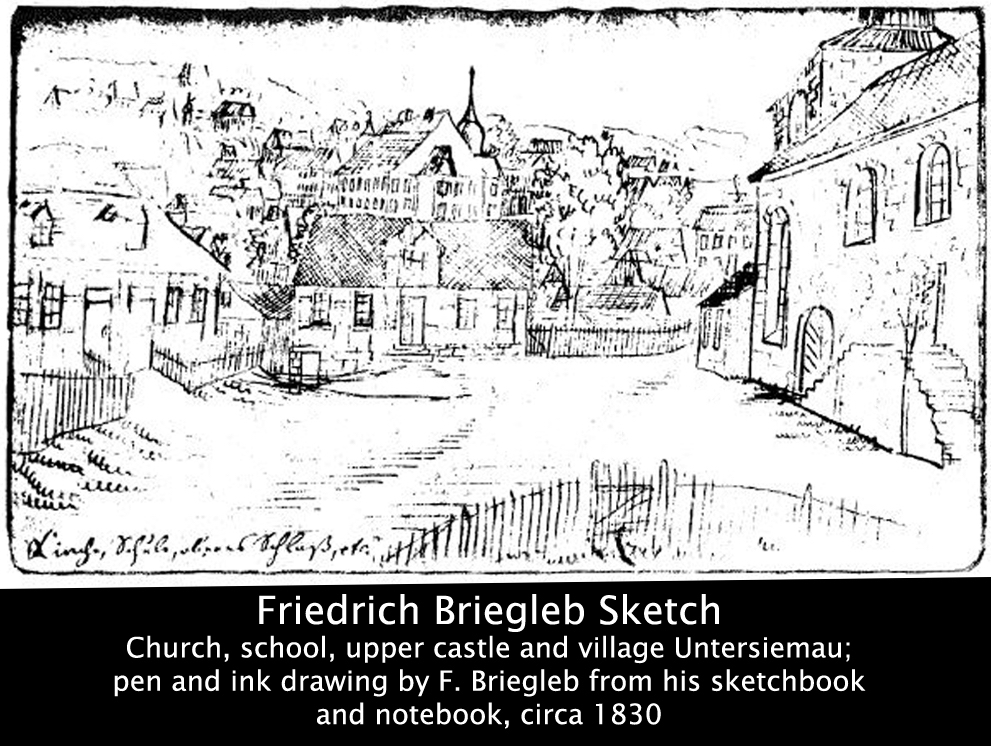
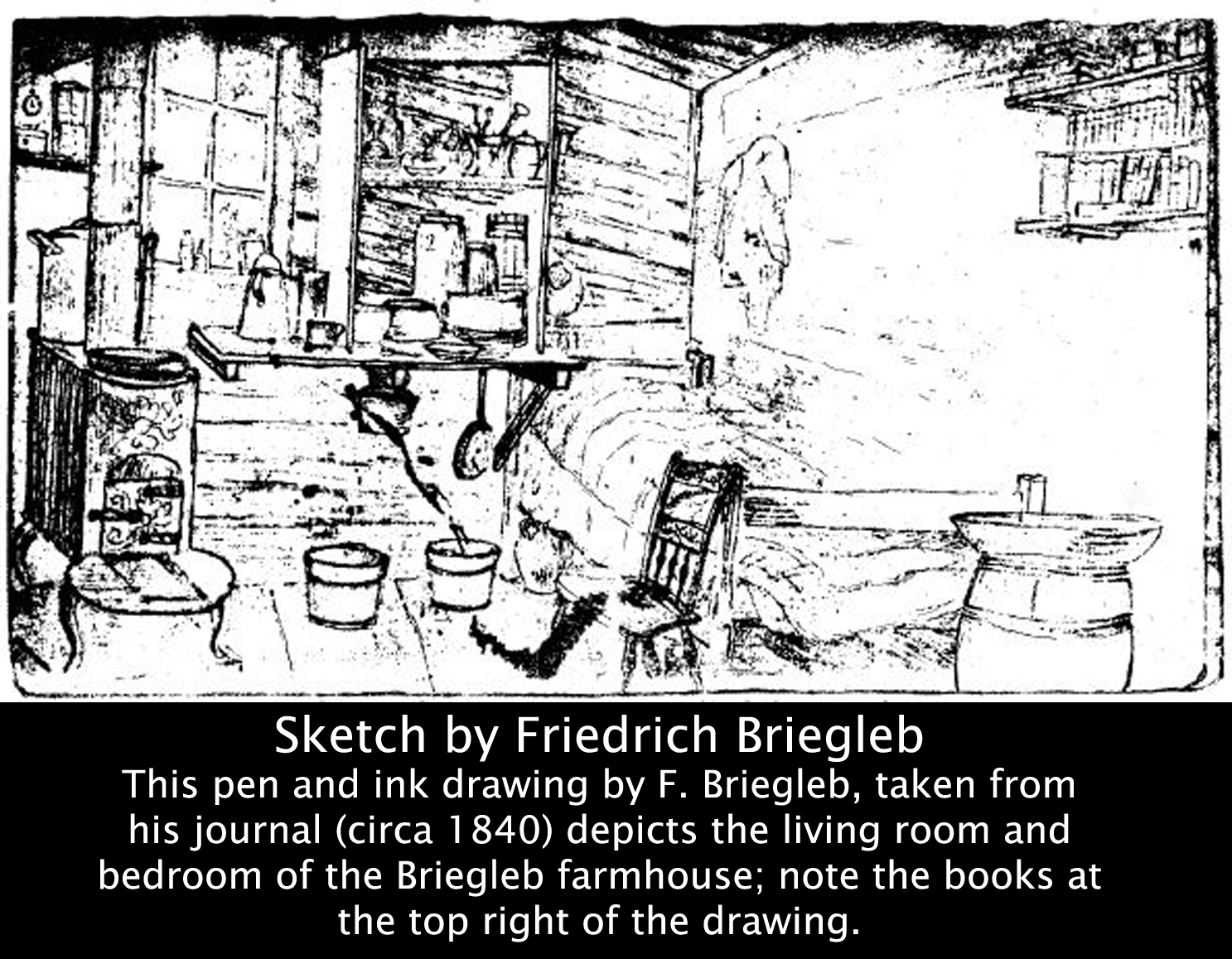
Missouri River. True to his roots, Friedrich became a teacher at a
boy's school in St. Louis. his
sketchbooks, which were passed down through the
generations of his family, contain drawings of
scenes not only from the two villages--Untersiemau (just to the south of Coburg)
and Weißenbrunn vorm Wald (just to the north)--where he was born and grew up, but of the
farm in Saint Clair that served as his first stop in
America. Friedrich married Margaret Doetchel (2/12/1815--1/10/1888) and ultimately fathered nine children.






Friedrich's forced departure from his homeland
seems to have prompted most of his sublings to follow him to Missouri. Ferdinand, Ida, Christel, Anna, Friederike, Johanna Clara, and Auguste all
left Germany between the years 1836 and 1840. Only
Emma, the oldest, stayed behind.***** Johanna Clara, who by then went by "Clara," made the crossing from Bremen to New
Orleans, arriving on November 19, 1839. Her name
appears as one of the 151 passengers of the
Nimrod (captained by Eugen Laun) as one of four
Briegleb sisters: Ida (24), Friedericke (19),
Clara (17), and Auguste (15), all originally from Coburg. Three and a half
years later, on March 22, 1844, she married Gerd Bremermann.
 By the time of the 1850 census, the Bremermanns had welcomed two children into the family: Joh[anna], age 6, and Ernest, age 5. "G. Bremermannan" is identified as a 36-year-old
merchant from Germany. In the 1860 census, Gerd's birthplace is specified as Bremen and
Clara's, "Saxony." By then the couple had
four children:
Johanna Bremermann (age 14), Ernest
Bremermann (age 12), Helena Bremermann
(age 3), and Robert Bremermann (age 1).
With them lived two other "Bremermanns" from
Bremen--Henry Bremermann (age 40) and
Conrad Bremmerman (age 15)--probably Gerd's
brother and nephew. Both are listed as "merchants," just like Gerd.
The census takers did not bother to specify the nature of Gerd's commercial interests, but ads and notices in the local newspapers as well as tax assessment records from the 1850s and early 1860s make it abundantly clear. The earliest mention of Gerd in the St. Louis press is an advertisement in the May 20, 1852 edition of the Anzeiger des Westens, drawing the reader's attention to Bremermann's i>Eisenwaaren Handlung, that is, his "hardware business," at "95 Carondelet Avenue toward Park Avenue." According to the ad, Gerd sold, both in bulk and by the piece, "ironware, steelware, and brassware, planes and tools of all sorts, cooper tools, hunting and other shotguns [Flinten], and so on, sold at the cheapest prices." This ad would run, with minor variations, until February 20, 1856. A notice appears in the March 24, 1857 edition of The St. Louis Republic, indicating that, on March 1, Gerd had formed a "copartnership of wholesale dealers in hardware and cutlery, guns, rifles, pistols, etc. at No. 3 Main Street." The Abend Anzeiger reported (in German) on the same merger that same day, adding to it a more detailed inventory of the products offered by "Bremermann, Rashkoe, & Co.", to wit, "a new and outstanding assortment of all types, foreign and domestic, of hardware, cutlery, and firearms, all recently imported from England, Germany, and eastern factories." Gerd's dominant role in this company lasted for almost six years, that is, until February 1863, when Gerd sold his leading share to one of his partners at the time, John F. Mense [The St. Louis Republic 21 Feb 1863; see also St. Louis Globe-Democrat same date]. Immediately under this notice is a short paragraph in which Gerd recommends his successor, John Mense, "to the favor of the customers of the old firm." And immediately after that plea is a notice indicating that a new "copartnership" had been formed called "Mense, Rashcoe, & Co. for the purpose of transacting a wholesale hardware business in this city, at the old stand of the late firm, 'G. Bremermann & Co., 3 South Main Street." Elsewhere in the same edition of The St. Louis Republic, Gerd's withdrawal from this partnership is described as a "retirement," though this must not have been meant in the traditional sense of the term for Gerd was still only 49 years old at the time. Moreover, it is clear from the newspaper advertisement evidence that Gerd he was still dealing hardware at his 1 N. Main Street location. The 1863 tax assessment list describes Gerd as a "wholesale dealer" located at 1 N. Main Street with taxable property estimated to be worth $100,000. According to next year's assessement, Gerd's value had grown to $155,000. The 1866 St. Louis City Directory we learn that "G. Bremermann & Co."--which lists him and one Julius W. Meyer as co-owners--dealt in "wholesale hardware and cutlery" with a business address of 1 N. Main Street. This is consistent with an ad in the January 20, 1866 edition of the Abend-Anzieger which refers to the wares of "G. Bremermann & Co.," which was located at 1 N. Main Street and which included Julius W. Meyer as a partner.
It is worth nothing that beyond these narrowly business-related data, the remaining references to Gerd Bremermann in the St. Louis press are sparse, to say the least. From them we know that Gerd took out an ad in the January 4 edition of the St. Louis Reporter, offering a five dollar reward to anyone returning three credit notes that had turned up missing." And on July 14, the Westliche Post covered a recent meeting of the "German Society" (Deutsche Gesellschaft), where Gerd was voted in as the "Director" of the 3rd Ward.
In July of 1866, Gerd officially recorded his last will and testament. It reads: "In the name of God, Amen, I, Gerd Bremermann, being of sound and disposing mind, do hereby make and declare the following to be my last will and testament, viz.: I give and bequeath to my beloved wife Clara Bremermann, one third part of the whole of my estate, be the same real, mixed, or personal property; the other two thirds parts of my estate shall be divided in equal shares among my children then living. I hereby appoint my said wife Clara Bremermann the executrix of this my last will and testament, whereof I hereunto set my hand and affix my seal this fifteenth day of July, A.D. eighteen hundred and sixty six." Gerd's mind was apparently sounder than his body, for he died less than fifteen months after setting his affairs in order. That was October 1, 1867, when he was still only 52 years of age. The Abend-Anzieger [Oct 2 1867] published a florid but singularly uninformative obituary the following day under the heading Tod des Hrn. G. Bremermann.
 It reads: "Among the victims that the most recent eight days have wrenched from our midst, Mr. Gerd Bremerman is to be counted, irresistable death having taken him from us yesterday morning far too soon, among grieving loved ones and a large circle of warm friends. Mr. Bremermann had taken ill the night between Saturday and Sunday [between September 28 and 29] and the skill of the doctors treating him did not succeed in keeping him alive. The deceased, who was during his lifetime the senior manager of a steel and ironware business, Bremermann & Co., was in earlier years associated with Bremermann, Roshcoe & Co., and after its dissolution, the firm Bremermann & Co., which later also came to an end to make way for new business ventures, of which Bremermann & Co. is one, and Mense, Rashcoe & Co. is the other. Mr. Bremermann had come here from Bremen about 30 years ago and worked his way from the ground up. In wide circles he enjoyed the reputation of being a realistic businessman, and to his closer acquaintances he was considered a highly likeable socialite, whose early death will be generally grieved." There is no indication as to the cause of Gerd's death. He was buried
in the Holy Ghost Cemetery.**** On October 5, 1867, a notice appeared in the Westliche Post from the St. Louis probate court advising anyone with claims against the estate of Gerd Bremmerman, "late of St. Louis County, deceased," to produce them within one year. Clara J. Bremermann is listed as the "executrix," as Gerd's had wished.
The Bremermann family
entry in the 1870 census
lists Gerd's widow Clara (age 47) as the held of
household, with her son Ernest (24) supporting the
family as a "clerk in store." Gerd and Clara's oldest
daughter Johanna is not mentioned; she moved out
when she married Gustav F. Seebold on
January 6, 1864. But Helena (13) and Robert (11)
are listed, however, along with Charles Bremermann
(9) and Clara Bremermann (7), both of whom
were born between the 1860 census and
their father's death in 1867. Clara, Sr., Gerd's widow, recorded her last will and testament on May 28, 1872: "I, Clara Johanna Bremermann, ... give and bequeath to my daughter, Helene A. Bremermann, one thousand dollars; to my son Robert G. Bremermann, one thousand dollars; to my son Charles M. Bremermann, one thousand dollars; and to my daughter Clara Bremermann, one thousand dollars; and all the rest and residue of my estate, real, personal, and mixed, remaining after the payment of all my just debts, of the expenses of my funeral, and of the above legacies, I give, devise, and bequeath to my six children, viz: my daughter Johanna L., wife of Gustave F. Seebold, my son Ernest L. Bremermann, my daughter Helene A. Bremermann, my son Robert G. Bremermann, my son Charles M. Bremermann, and my daughter Clara Bremermann. I appoint my son, Ernest L. Bremermann or in case of his death, inability, or refusal to act, my nephew Augustus Steitz, the executor of this my only last will and testament. I also appoint my son Ernest L. Bremermann, or in case of his death, inability, or refusal to act, my nephew Augustus Steitz, the guardian of those of my children who shall be still under lawful age at the time of my decease." Clara died only fourteen months later on July 20, 1873. She was only 51 years old at the time. The following August, the Missouri Republic [Aug 8 1873] reported that her oldest son "Ernest L. Bremmerman" had assumed control of his widowed mother's estate, valued at $40,000.
The 1876-77 catalogue of Washington University in
St. Louis lists four of the younger Bremermann children as
students in its preparatory schools. Founded
by William Greenleaf Eliot, the university
housed a school for boys (the Smith Academy, which
Eliot's grandson, T.S. Eliot, would later attend), founded in 1854,
and a school for girls (the Mary
Institute, named for Eliot's late daughter Mary
Rhodes Eliot, who had died at 17), founded in
1859. "Robert G. Bremermann" appears (p. 23) as a
"Preparatory Scientific class" student in the
"Academy;" he would have been eighteen at the
time. His fifteen-year-old brother "Charles M[atthias].
Bremermann" is listed (p. 19) as one of the
students in the "third class" of the Academy. In
the same catalogue, "Helen A. Bremermann," age
sixteen, is listed as a "second academic class"
student at the Mary Institute (p. 34), along with
her thirteen-year-old sister Clara Bremermann (p. 37), a
member of the "first preparatory class." All four
are listed as residents of 928 Winter Street. Clara does not seem to have attended high school there. The June 29, 1880 edition of the St. Louis Globe Democrat listed high school artists from the "Franklin Branch High School," among them Clara Bremermann, who had distinguished herself in the category of "crayon Drawings from objects."
The 1880 census
takers found Ernest (age 33) serving as the head
of the Bremermann household at 928 Winter Street,
employed as an "engineer;" the occupation and address are confirmed by the St. Louis City Directory of the same year. Ernest's sister Helen (22) added to the
family income by plying her skills as a music
teacher, while Robert (20) worked as a store
clerk. Charles (18) and Clara (16) were still in
school.
 Charles Matthias Bremermann (b. 6/27/1861), who was closest in age to Clara, would go on to attend Missouri Dental College, graduating in 1882. He married Lola Abbie Felt of Wisconsin (b. 1/17/1864) in Barnes, Kansas on May 19, 1885. Their two children, Luella (b. 9/30/1886) and Glen Bremermann (b. 7/15/1888) were both in Greenleaf, Kansas, and St. Louis respectively, suggesting that Charles began his dental practice in Greenleaf before relocating to St. Louis between in 1887 and early 1888.
For her part, Clara married Eugene Wolf (age 23) on July 22, 1883, just short of her twentieth birthday. Despite the St. Louis roots of both the bride and the groom, the ceremony took place in Greenleaf, Kansas. This suggests that Clara was close to her brother Charles and may, at least for a time, have thought about moving with Eugene to Kansas.
Fast-forward fourteen years, and we learn from an obituary in The Indianapolis Journal [Sept 17 1897] that Clara and Charles' oldest brother Ernest Bremermann died of "Consumption" on September 16, 1897. He had been living in Indianapolis since 1891, working as an "employe[e] in the city engineer's department." The obituary reveals that Ernest "had been given a scientific education in Europe when a young man, his father having been a wealthy St. Louis man." The article also notes that Ernest "was employed on the first St. Louis bridge by Engineer Eads, and while at this work invented a device for testing iron." The exact nature of Ernest's invention is not clear, but the bridge and its architect, James Buchanan Eads, are both famous. The first ever steel-truss bridge, the Eads bridge, was no small feat of engineering, given the width of the river separating St. Louis, Missouri, and East St. Louis, Illinois. Completed over a seven-year period between 1867 and 1874, the bridge is very much in use today, bearing the distinction of being the oldest bridge on the Mississippi River. Ernest's specific role in this colossal project is not known.
Less that four years after the loss of he older brother, Ernest, Clara would suffer another family tragedy. On July 30, 1901 her husband Eugene succombed to Tuberculosis. By then the couple, with their three young children, had relocated from St. Louis to the "healthier" climate of Denver, the way so many families affected by this disease did at the time.
_______________________________
** The information about Johann August Briegleb's
accomplishments and his three sons' emigration to
Missouri comes mostly from the genealogical notes of C. F.
Briegleb of St. Clair, Missouri, a grandson of
Fritz Briegleb, the third of Johann and Johanna's
children.
***SLCDR Volume 1, p. 736.
**** The Holy Ghost Cemetery--where Guvtav Wolf
was buried in 1860--was established in 1846 as the
first German cemetery in St. Louis. It is located
at 7153 Gravois Road, just east of Grand. It was
also known as "Picker's Cemetery" (and then "Old
Picker's Cemetery") after Frederick Picker, the
pastor of the "German Evangelical Church of the
Holy Ghost" in St. Louis from 1843 to 1855.
Reverend Picker is, in fact, the one who married
Gerd Bremermann and Johanna Clara Bregler and
recorded the deed in the book of
marriages.
***** This information comes primarily from the genealogical notes of
C. F. Briegleb and the Briegleb tree.